
Introduction
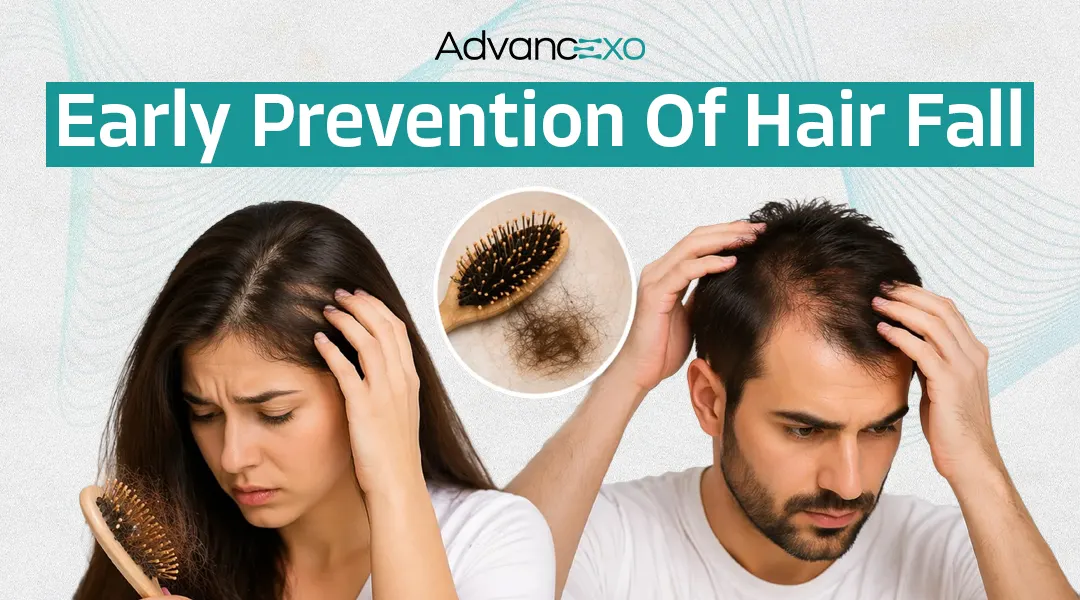
Hair shedding is far more than just a cosmetic concern. It affects an individual’s confidence, self-image, psychological wellbeing and quality of life. The current advances in regenerative approaches with exosomes have enabled dermatologists to support hair biology. Instead of simply masking the hair fall, exosomes target scalp improvement and restore natural signals to restore dormant hair follicles.
Every hair follicle’s fate depends on the complex coordination of an individual’s intrinsic factors like cellular communication, growth factors, adequate nutrient availability, and a healthier scalp microenvironment. The disruption of this coordination due to genetics, chronic stress, inflammation, nutritional deficiencies, and hormonal fluctuations affects the adequate hair cycle.
With the latest innovation in regenerative medicine, the interest has shifted towards an advanced approach. But can exosomes offer a long-term hair fall solution? How do they have advantages over conventional Hair Fall Treatment? Or, who can benefit from hair regrowth treatment? This blog unveils the science behind hair fall causes and the role of exosomes in hair regrowth.
When Is Hair Fall a Concern?
Most individuals lose up to 100 hair strands regularly as part of the normal hair cycle. New hair strands compensate for the hair shedding. When someone sheds more hair with no or fewer hairs growing back, it causes real concern. Understanding hair fall causes is crucial in determining adequate treatment options.
Understanding the Real Hair Fall Causes
Hair Fall can be Temporary, Progressive or Permanent Depending on its Causes. The Most Common Hair Fall Causes Include:
- Hereditary Baldness (Androgenetic Alopecia): Affects both males and females, develops progressively due to excessive androgen production.
- Autoimmune Cause (Alopecia Areata): The individual’s own immune cells attack hair follicles as foreign. Hair loss can occur at any age and quickly.
- Telogen Effluvium: Rapid hair shedding in a shorter duration. Physical or emotional stress potentially triggers telogen effluvium
- Hormonal Fluctuation: Often accounts for temporary hair loss. Changes in hormonal patterns, such as estrogen, prolactin, progesterone, etc., trigger hair loss. Common among women at the time of pregnancy, childbirth or menopause. Among men, testosterone fluctuation causes hair loss.
- Side Effects: Intake of certain medications or medical procedures (chemotherapy) leads to hair losses
Where Traditional Hair Fall Treatments Fall Short?
Traditional hair fall treatments are well-established to combat hair thinning. Dermatologists often enquire about family history, medical history of the individuals, run laboratory tests and examine the scalp to determine the actual Hair Fall Cause. Common hair fall treatment products or regimes available include:
Hair Care Products
- Involves the application of topical products
- Includes hair oil, serum, balancing shampoo, conditioner, etc,
- Targeted scalp problem-related products (dandruff, weak roots, etc.)
- These products cannot cure medical-grade hair loss, nor can they change hair’s genetic structure
Nutritional Supplementation
- Dietary intake of micronutrients, including iron, zinc, vitamin D, biotin, etc.
- Targets stress or inflammation and promotes hair loss
- Oversupplementation can trigger or worsen hair loss
- High dosage of zinc can hinder iron absorption, and excessive selenium can lead to selenium toxicity
Medications
- Minoxidil is recommended as the first course of hair regrowth treatment
- Oral medication like finasteride is recommended for patterned baldness
- Medication can incur side effects like scalp irritation, low libido, depression, etc.
Plasma-Rich Platelet (PRP) Therapy
- The candidate’s own blood is drawn and centrifuged
- Plasma injected at the target site slows down hair loss
- The plasma preparation is rich in growth factors, which boost new hair regrowth
- Results can be inconsistent; the availability of growth factors depends on age and the health of the individual
Hair Transplantation
- Hair strand removed from the area of the scalp where hair growth is thick
- Hair stand graft transplanted at the target area
- Not effective in case of ongoing hair loss
- Therapy success depends on the health and age of the individuals
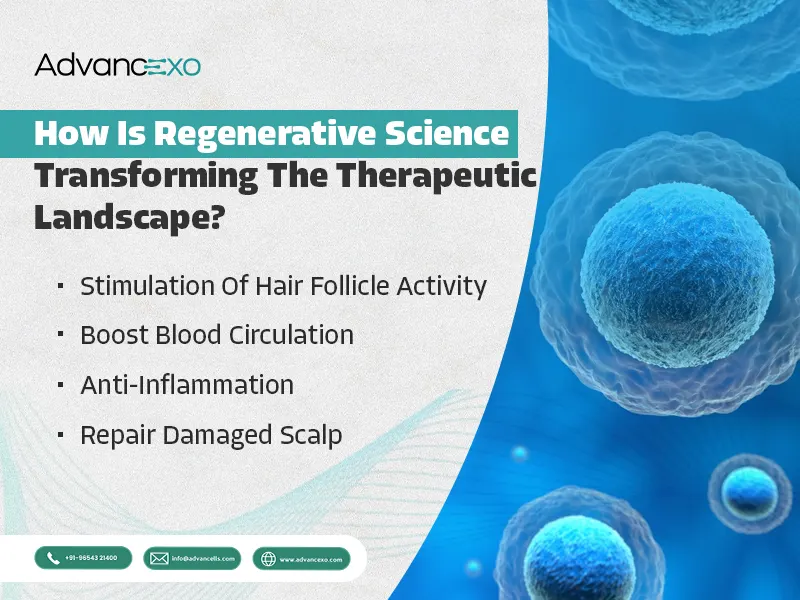
How is Regenerative Science Transforming the Therapeutic Landscape?
Exosomes for Hair Growth are believed to be the next-generation hair regrowth treatment. These are tiny nano-sized molecules (30-150 nm) that are released by cells. Researchers have widely explored exosomes isolated from mesenchymal stem cells (MSCs) as they are a rich source of growth factors, cytokines, and signalling molecules. Exosomes act as cargos that transport various bioactive molecules, including proteins, lipids, microRNAs, cytokines, and growth factors. They stimulate follicular regeneration and reduce inflammation.
The Mechanism of Action of Exosomes for Hair Growth Involves:
Stimulation of Hair Follicle Activity
- Stimulates dermal papilla cells, activates dormant hair follicle stem cells.
- Enhance proliferation of dermal papilla cells.
- Pushes the follicle into the anagen (growth) phase of the hair cycle
Boost Blood Circulation
- Exosomes release various growth factors (VEGF, FGF)
- Promotes angiogenesis
- Facilitate an adequate supply of oxygen, nutrients, and blood to the scalp.
Anti-Inflammation
- Exosomes releases various anti-inflammatory molecules (IL-10, TGF-β, M2 macrophage polarization)
- Neutralises the effect of pro-inflammatory signals and the inflammatory cascade (NF-κ B)
- Modulates immune response, protects hair follicles.
Repair Damaged Scalp
- Supports tissue regeneration, repairing damage caused by harsh treatment.
- Supports other hair treatment regimens like PRP, transplantation or microneedling
- Modulates signalling pathways (Wnt/β-catenin), extends anagen phase.
- Creates a supportive scalp microenvironment, protects the existing hair follicle
Who are Ideal Candidates for Exosomes?
Based on hair assessment outcomes, dermatologists recommend exosomes for hair regrowth. It is ideal for candidates suffering from:
- Early to moderate stage of hair thinning
- Male/Female patterned hair loss
- Diffuse hair shedding
- Stress-related hair fall
- Candidates seeking a minimally invasive hair regrowth option and a long-term solution
Comparative Analysis: Regenerative vs. Conventional Approach
| Features | Exosomes | Medication | PRP | Hair Transplantation |
| Approach | Introduce regenerative cell signalling | Controls hair loss progression | Patient’s own blood drawn to gain growth factor enriched plasma | Surgical procedure |
| Mechanism of Action | Stimulates cellular communication, modulate cell signalling | Targets hormonal pathways | Delivers growth factors rich plasma to the targeted region | Hair graft relocation |
| Suitable Candidates | Early to moderate hair thinning | Patterned hair loss | Early | Advanced Hair loss |
| Invasive | Minimally invasive | non-invasive | Invasive with use of injection | Surgical procedure |
| Downtime | Minimal | None | Minimal | Several days to weeks |
| Longevity | High with maintenance | Continued use required | Frequent repetitive session required | Long-lasting with maintanace |
What to Expect During an Exosome Application?
Some Applications Account for Multi-Stage Processes. This Involves:
- Consultation: Consideration of the candidate’s medical history, scalp assessment, and determination of hair fall causes
- Exosome Procurement: Dermatologists gain clinical-grade exosomes for application
- Scalp Preparation: Cleaning and preparation of the scalp. Local anaesthesia might be introduced based on the scalp preparation protocol.
- Application: Exosomes are topically massaged on the pre-prepared target area of the scalp
- Downtime: the individual can resume their daily life activities soon after the procedure
- Aftercare: Dermatologists provide detailed guidelines related to the aftercare products. Avoid direct sun exposure, intense heat, swimming or sauna for at least 48-72 hours after the procedure.
- Follow-Ups: Progress is monitored at a desirable time interval. For the best outcome, more than 1 session is recommended.
How to Maximise Hair Regrowth Results?
Exosomes for Hair Growth Procedure Success Depends on Certain Factors, Including:
- Use of superior quality, clinical-grade exosomes
- Individual factors like health, age, and intrinsic response
- Intake of balanced nutritional intake
- Scalp care, avoid excessive sweating activities
- Stress management and adequate sleep
- Avoid excessive heat or chemical treatment
- Consistency in follow-ups and aftercare
*Advanexo, India, is a leading clinical-grade exosome supplier for hair and skin rejuvenation. The products undergo stringent quality checks and come with a Certificate of Authentication (CoA).
Conclusion
Hair loss can potentially be caused due to multiple factors. Timely consultation and adequate management can introduce long-term solutions. Exosomes for hair growth are an advanced modern approach that rejuvenates hair from within. A combination of exosome application along with conventional treatment approaches enables a better outcome.
FAQ’s
Q- Are Exosomes an Effective Hair Fall Solution for Both Men and Women?
Yes, current clinical evidence shows a positive effect of the exosome as a hair fall solution for both men and women.
Q- How Many Exosome Hair Regrowth Treatment Sessions are Typically Recommended?
The number of sessions depends on individual factors. The overall outcome is influenced by the quality of the exosome, hair fall cause, stage, severity, and the individual’s response towards the exosome application procedure. For some individuals, noticeable changes appear after the first session, while for others, 3-4 sessions might be required.
Q- Can Exosome Hair Fall Treatment be Combined with PRP or Hair Transplant Procedures?
Yes, the application of exosomes in combination with PRP or hair transplantation is an excellent choice.


Outstanding post but I was wondering if you could write a litte more on this subject?
I’d be very thankful if you could elaborate a little bit more.
Kudos!
Glad that you liked our post. For more information you may visit our website: https://advancexo.com/ For detailed information contact us via WhatsApp or call us at +91-9654321400, or mail us on info@advancells.com for more information. We’re here to support you every step of the way.