
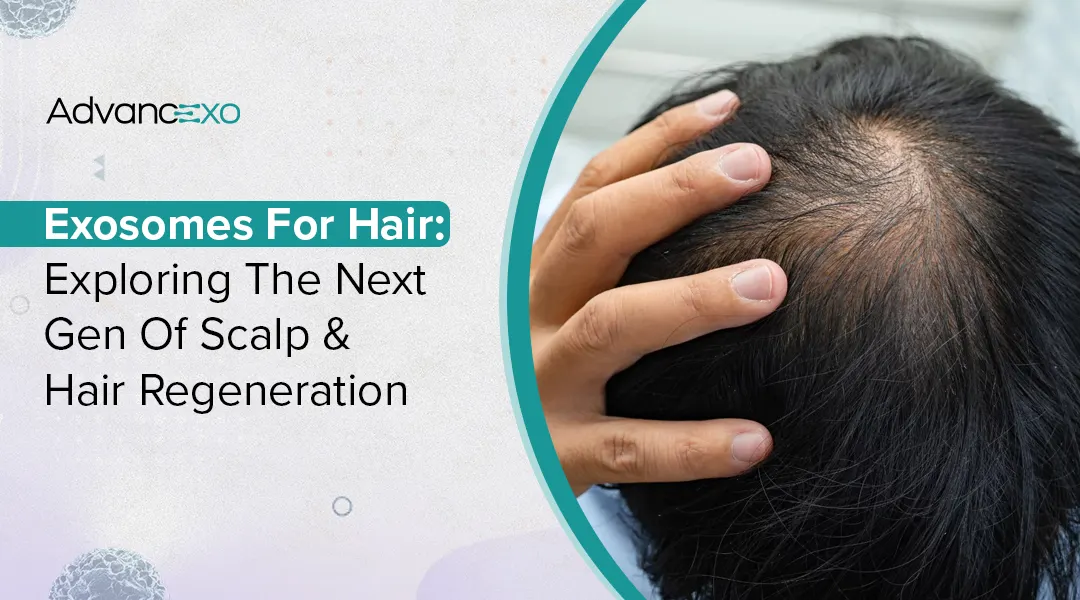
Hair loss does not begin with losing some hair strands. The condition appears progressively before it becomes evident. Visible signs, such as receding hairline, excess hair shedding, or hair texture alteration appears. Such noticeable changes raise certain questions like: Why is my hair thinning? How do hair follicles strengthen? How does hair get restored efficiently?
Such questions are reshaping the future of aesthetic dermatology. Moving beyond conventional hair loss management, attention has shifted towards regenerative approaches. The intent is to regulate the scalp microenvironment and promote cellular communication. Towards this goal, exosomes for hair have gained significant research and clinical application interest.
The real question is where science stands with exosome application? What are the potential Benefits of Exosomes for Hair, or how do exosomes for hair act differently alongside the established approach? This article explores the key benefits of exosomes for hair for various hair-related problems.
Why Are Exosomes Gaining Attention In Hair Science?
Exosomes are naturally released tiny extracellular vesicles by the cells and are often referred to as a tiny sac (fat/lipid) consisting of molecules. Researchers widely source exosomes from umbilical cord-derived mesenchymal stem cells (UCMSCs) to gain superior quality exosomes for aesthetic use. These are nano-sized molecules (30-150 nm) that act as post-market inside the body. Mechanistically, exosomes carry a concentrated amount of essential proteins, microRNAs, cytokines, growth factors, lipids and signalling molecules.
Exosomes for hair are suitable for Indian scalp issues. Research showed the potential of exosomes for hair in increasing dermal papilla cell proliferation, modulating oxidative stress and inflammation and improving the scalp microenvironment. Exosomes potentially support new blood vessel formation that ensures adequate flow of nutrients and oxygen in the scalp.
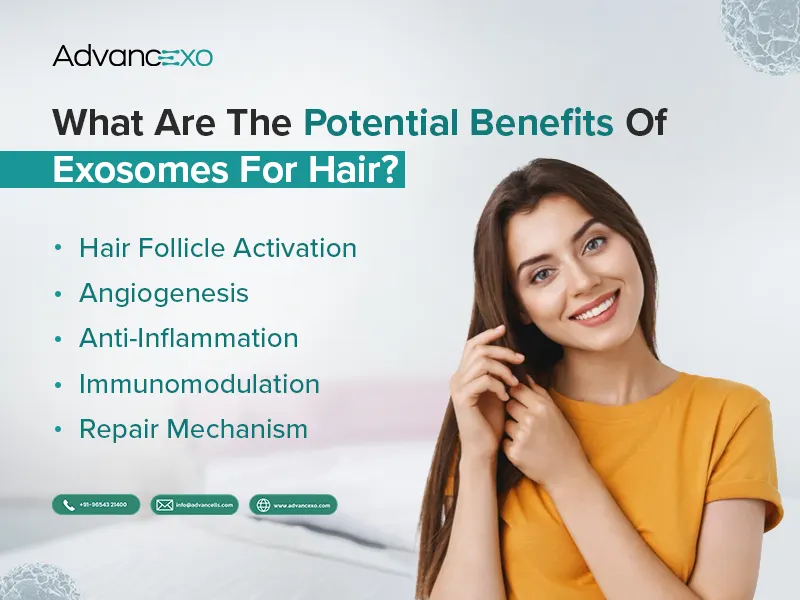
What Are the Potential Benefits of Exosomes for Hair?
Possible mechanisms proposed by researchers in introducing Exosomes for Hair Regrowth Treatment include:
Hair Follicle Activation
Exosomes release various cytokines and signalling molecules that activate dormant hair follicles. They push the hair follicle towards the anagen phase (growth phase) of the hair cycle. It boosts hair regrowth and supports hair health
Angiogenesis
Exosomes release various growth signalling molecules including VEGF, FGF, etc. They promote new blood vessel formation. The supply of blood, nutrients, and oxygen in the scalp area increases
Anti-Inflammation
Exosomes release various anti-inflammatory cytokines (IL-10, TGF-β), microRNAs (miR-146a), etc. that block or modulate inflammatory signals. They neutralize the effects of pro-inflammatory molecules and create a supportive microenvironment
Immunomodulation
Exosomes modulate the immune response. It reduces the risk of treatment rejection and creates a favourable environment for hair growth
Repair Mechanism
Exosomes release various growth factors and signalling molecules. It boosts cellular communication. It boosts hair regrowth via activating the body’s natural repair mechanism. Improvement in cellular processes like cell proliferation, differentiation and survival occurs.
From Scalp Biology to Visible Results: What Does the Evidence Tell Us?
Currently, the application of exosomes for hair is rapidly evolving in both preclinical and clinical studies. Although the evidence is still evolving, the early outcome looks promising. The emerging evidence suggests:
- Change in Hair Density: The majority of individuals reported hair density improvement post-exosome therapy
- Improvement in Hair Shaft Thickness: Improved hair diameter and thickness are reported. The number of hair follicles increased.
- Improvement in Scalp Environment: Potential improvement in cellular communication, reduced scalp inflammation, and modulation in follicular activities
- Reduced Hair Shedding: Modification in the hair shedding pattern, reduced unnatural hair fall [1]
*NOTE: The candidates opting for exosomes for hair rejuvenation must make a sound decision. Do not rely on images related to ‘Exosomes for Hair Loss Before and After’. We recommend you take a detailed account of standalone proof. Based on the individual’s response, the dermatologist recommends follow-ups. Consistent follow-up significantly enables gaining the full benefits of exosomes for hair rejuvenation.
Where Does It Fit in a Dermatology Practice?
Dermatologists Consider Certain Conditions When Considering Exosome Treatment for Hair. This Includes:
Pre-Treatment Consideration
Before considering exosome treatment for hair, dermatologists assess the underlying cause of the hair loss. Various loss indications include androgenetic alopecia (pattern hair loss), alopecia areata (autoimmune), hormonal fluctuation, telogen effluvium, etc.
Diagnosis for Treatment
It is crucial to determine the hair loss cause before recommending an exosome-based treatment approach
Broader Hair Restoration Plan
Exosome-based approaches potentially are part of long-term hair restoration strategies. Dermatologists opt for exosomes for hair alone or in combination with other conventional hair treatment regimens for hair restoration.
Individualized Approach
Dermatologists consider factors including age, hair loss severity, underlying cause, duration, etc. to determine treatment suitability. Exosomes work for many when the conventional method fails.
Realistic Expectation
Benefits of exosomes for hair vary among individuals. Set realistic expectations. Exosomes should not be considered as part of a universal hair rejuvenation solution.
*NOTE: The quality, source, and storage of the exosomes play a crucial role in ensuring their efficacy. Advancexo, India is a leading clinical-grade exosome supplier for hair and skin rejuvenation. The product comes with a Certificate of Authentication (CoA).
Are Exosomes for Hair Worth Considering?
Exosomes for hair or skin rejuvenation are at an early stage of clinical application. There are certain factors that must be carefully considered by both dermatologists and candidates. Before choosing exosomes, look out for certain information, including:
- Source and Origin: Product source must be documented
- Manufacturing: To ensure consistency between the product batches cross-check the manufacturing procedure and handling information
- Purity: The product must undergo strict quality control
- Characterization: Exosomes undergo characterization to determine the presence of quality markers
- Concentration and Formulation: Preparation, concentration and formulation affect product quality and efficacy
- Handling and Storage: Information including adequate storage conditions, shelf life, handling procedure, and transportation must remain intact
*NOTE: Dermatologists and candidates undergoing exosome treatment for hair must cross-check availability of this information. To ensure maximum benefits of exosomes for hair, the product quality and patient’s suitability have a pivotal role
Key Takeaways
- Clinical evidence associated with Exosomes for hair is still evolving
- The benefits of exosomes for hair look promising. They induce these effects intrinsically, including boosting cellular communication, anti-inflammation, immunomodulation, and creating a healthier scalp microenvironment
- Considering exosome quality and adequate patient selection have a pivotal role in treatment success
- There is a need for a large-scale clinical trial to establish long-term safety and efficacy of the treatment
References
- Poddar N, Aratikatla A, Gupta A. Therapeutic potential of stem cell-derived exosomes in hair regeneration: A systematic review. World Journal of Stem Cells. 2025 Jul 26;17(7):108519.
FAQ’s
Q- Are Exosomes Effective for all Types of Hair Loss?
No, hair loss can appear due to various causes including genetic, autoimmune, hormonal fluctuation, nutritional deficiencies, etc. Exosomes are effective when the hair follicle still exists in the scalp. In case of complete follicular loss, exosomes can fail in their action.
Q- How Long Does it Take to See Results?
The duration/timeline of the result outcome varies among individuals. The key considerations include hair loss pattern or cause, follicular health, exosome quality, individual’s response post-procedure and aftercare. For some individuals, visible results might appear after the first session, while for others it might require 3-4 sessions.
Q- Can Exosomes be Combined with Other Hair Regrowth Treatments?
Yes, exosomes are safe to combine with any other conventional hair regrowth method. Dermatologists often recommend exosomes for hair as a supportive option.
Q- What is Considered About Exosomes for Hair Rejuvenation?
Exosome quality, source, isolation procedure, characterization, CoA, storage requirement, handling instruction, and available evidence.


Pingback: Hair Thinning: Explore Exosome-Based Hair Care