
Hair thinning begins silently and often goes unnoticed. Various conditions such as genetic factors, hormonal fluctuations, prolonged stress, nutritional deficiencies, or lifestyle factors adversely affect the follicular health.
Losing 50-100 strands daily is a normal part of the healthy hair cycle. However, losing more strands gradually becomes visible. The parting becomes wider, and overall hair density feels different. With widespread causes of hair thinning, choosing an adequate Hair Thinning Treatment becomes challenging. While the conventional approaches are well-established, they address the changes superficially. With emerging regenerative aesthetic approaches, the attention has shifted towards understanding hair follicle biology. Exosomes have evolved rapidly as bioactive molecular cargo that can modulate cellular signaling. Dermatologists are introducing exosomes to create a supportive scalp microenvironment and address hair thinning or hair loss at the cellular level. The current article unveils five key facts about exosome science and their potential role in hair thinning treatment.
What are the Causes of Hair Thinning?
The Hair Thinning Causes are Potentially Multifactorial. This Includes:
- Genetic or Hereditary Cause: Commonly known as androgenetic alopecia, which leads to patterned baldness among men and women. Among men, the hair recedes from the hairline, while in females, the effect is visible in the crown area
- Autoimmune Condition: Clinically known as alopecia areata. This is an autoimmune condition where an individual’s body treats the hair follicle as foreign
- Hormonal Fluctuation: Often considered a temporary cause of hair thinning. Pregnancy, menopause, or thyroid fluctuation can potentially trigger hair thinning
- Nutritional Factors: Dietary deficiencies including lack of adequate protein, biotin, zinc, Vit B3, Vit D, iron, etc.
- Environmental Factors: Prolonged or regular exposure to environmental pollutants or toxins. Arsenic, thallium, lithium, or mercury poisoning leads to follicular miniaturization
- Stress: A condition called telogen effluvium leads to non-scarring hair loss. The condition gets triggered by prolonged physical and emotional stress. Other conditions include severe infection, certain medications, traumatic injury, crash dieting, acute febrile illness, etc.
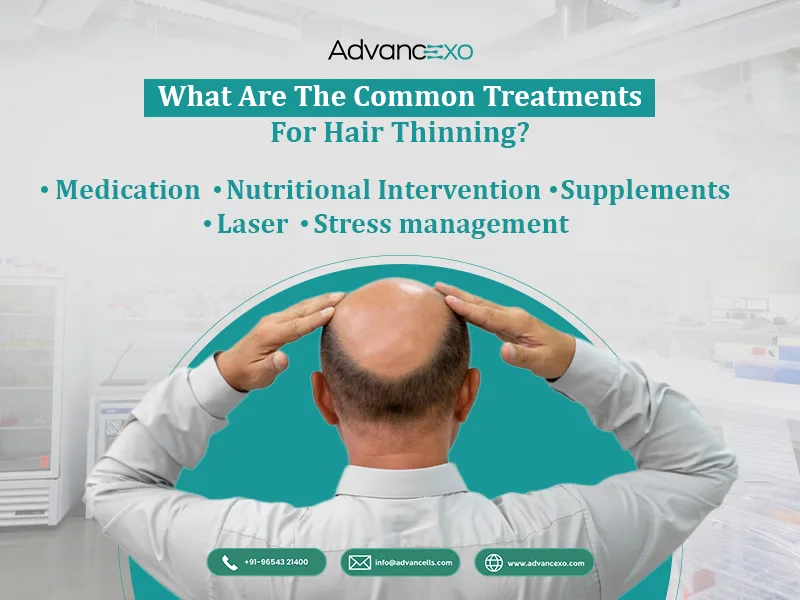
What are the Common Treatments for Hair Thinning?
The Conventional Hair Thinning Treatment Involves:
- Medication: Minoxidil and finasteride are the most common medications to combat hair loss. Corticosteroids are introduced to treat inflammation and autoimmune hair loss
- Nutritional Intervention: Intake of a nutrient-rich diet including high fiber, protein, fats, and micronutrients
- Supplements: Intake of folic acid supplements, biotin, multivitamins, omega-3 and omega-6 fatty acids, etc.
- Laser: For the stimulation of the weaker hair follicle, encouraging new hair growth
- Stress management: Long-term stress significantly increases cortisol (stress hormone) levels, which disrupts the natural growth cycle. Stress management via introducing medication or relaxation therapy is introduced
*NOTE: The above treatment approaches address the hair thinning problem at a superficial level. Besides, medications potentially can have side effects such as contact dermatitis, skin irritation, ED, decreased libido, gynecomastia, etc. The existence of such challenges has encouraged researchers to explore advanced natural solutions. With the emergence of regenerative aesthetics, the underlying hair thinning causes can be potentially targeted at the cellular level.
How are Exosomes Evolving in Regenerative Aesthetics?
Exosomes are tiny nano-sized extracellular vesicles that are secreted by cells. Researchers have widely used mesenchymal stem cell (MSC)-derived exosomes in regenerative aesthetic applications. These tiny molecules act as bioactive cargoes. They carry concentrated active biomolecules, including proteins, microRNAs, cytokines, growth factors, and signaling molecules. They exert therapeutic effects via multiple cellular or molecular mechanisms. The targeted region or the recipient cells take up these tiny cargoes, where all the bioactive molecules get engaged in multiple cellular mechanisms, including anti-inflammation, immunomodulation, boosting repair mechanisms, and creating a supportive scalp microenvironment. The exclusivity of exosomes in introducing Hair Regrowth for Thinning Hair is multifold as follows:
Fact #1: Exosomes are Signaling Cargo
Myth
Exosomes are Living Cells that Grow into New Hair Follicles
Fact Check
- Exosomes are tiny extracellular vesicles (50-150 nm) released by cells
- Exosomes release various growth factors and signaling molecules; they promote cell-to-cell communication
- Unlike cell-based approaches, exosomes do not involve the introduction of living cells
- They potentially modulate signaling in the follicular environment
- Preclinical studies reported exosome-associated effects on dermal papilla cells, signaling pathways, and hair follicle stem cells
- The clinical effect of exosome application depends on its source, bioactive molecule composition, formulation, and delivery approaches
Fact #2: Hair follicle responds to its microenvironment
Myth
Hair Growth or Regrowth Depends on the Hair Follicle Alone
Fact Check
- Hair follicles are influenced by complex interactions of the follicular cells, dermal papilla, and surrounding signaling pathways.
- Hair follicle behavior is dependent on the coordinated interaction between epithelial and mesenchymal compartments
- Dermal papilla cells have a crucial regulatory role in signal transduction
- Hair growth follows typical cyclical processes including anagen (growth), catagen (regression), and telogen (resting) phase. The surrounding environment influences follicular transition between the phases
Fact #3: Exosome-based approaches extend follicular support
Myth
Exosome Application Makes Hair Regrowth Impromptu
Fact Check
- Exosomes introduce changes at the cellular level (anti-inflammation, immunomodulation, regulate repair mechanism, etc.)
- They boost cell-to-cell communication and create supportive scalp microenvironment
- Modulates signaling between dermal papilla cells, angiogenic signaling, and follicular stem cells
- Introduces significant positive outcomes in terms of hair density and hair-shaft thickness
- The outcome depends on the individual’s factors, exosome quality, preparation, and administration
Fact #4: Exosomes are not a one-size-fits-all solution
Myth
Exosomes for Hair Thinning Work Equally on Every Hair Type
Fact Check
- Hair thinning causes are distinct and thus require a distinct treatment plan
- A detailed clinical assessment is required for identification of pattern or hair loss duration, shedding history, family history, hormonal changes, etc.
- Exosome application works well with non-scarring hair loss cases
- The outcome for other types remains different
- Dermatologists often combine established treatment approaches like microneedling and PRP with exosomes as the Best Treatment for Hair Thinning
Fact #5: Product quality, application, and individual factors influence the outcome
Myth
Any Product Labeled As ’Exosome-Based’ Has Equivalent Outcome
Fact Check
- Exosome source, isolation procedure, composition, storage, etc. all influence exosome quality
- Well-characterization and standardized formulation have significantly positive outcomes
- Availability of relevant biomarkers must be considered for adequate biological activities
- Exosome application of the delivery method influences the outcome. For example, topical application, assisted delivery, or intradermal delivery depends on the specific candidate’s needs
*NOTE: Individuals opting for exosome-based Hair Thinning Treatment must rely on an evidence-based approach. Consult an experienced dermatologist and renowned clinic. Set clear expectations related to the possible outcome. Advancexo, India, is a leading clinical-grade exosome supplier for skin and hair rejuvenation. We work with cutting-edge regenerative aesthetic technology. Each product batch is formulated using an indigenously standardized protocol and characterized. The product comes with a Certificate of authentication (CoA).
What are Realistic Expectations from Exosome-Based Hair Care?
- Exosome-based approaches influence hair thinning at the cellular level
- Improved hair density and hair quality occur gradually. Supportive care, including adequate nutritional intake and hair care, aids in better outcomes
- The outcome depends on various factors, including exosome quality, isolation procedure, administration procedure, hair thinning causes, severity, and the individual’s overall health status
- It is crucial to set realistic expectations
*NOTE: Currently, exosomes for hair thinning treatment are still evolving. In the future, large-scale studies focusing on protocol standardization and considering larger populations can potentially establish long-term efficacy
Conclusion
Hair thinning is a common problem, but they potentially have unique causes. In case of excessive hair shedding, one must turn to the dermatologist. The assessment of scalp condition, follicular health, and hair cycle changes all influence treatment goals. Dermatologists introduce an exosome-based approach in the form of a personalized hair thinning treatment plan.
FAQ’s
Q- What are the Main Hair Thinning Causes?
Common hair thinning causes include androgenetic alopecia, hormonal fluctuations, alopecia areata, nutritional deficiencies, prolonged stress, telogen effluvium, medications or certain treatment side effects, etc.
Q- Can Exosomes Help with Hair Thinning?
Preclinical and early clinical evidence suggest a positive trend in hair regrowth. Exosomes act at cellular level. They modulate follicular signaling and support the scalp microenvironment.
Q- Are Exosomes Suitable for Every Type of Hair Thinning?
No, different conditions cause hair thinning in different ways. A dermatologist should first assess the pattern, duration, and likely cause before considering an exosome-based approach.
Q- Can Exosomes Combined with other Hair Thinning Treatments?
Yes, dermatologists often combine exosomes with other hair thin treatments as the best treatment for hair thinning.


