How Exosomes Are Transforming Hair Regrowth?
What if hair loss is reversed via modifying cellular signals and restoring follicular signals?
Hair loss (alopecia) deals with an interrupted body’s hair production cycle. It is a widespread problem affecting approximately 80% men and 50% women globally. Conventional hair treatment, such as medications, grafting, laser therapy, etc., focuses on superficial treatments. Currently, the rise of regenerative dermatology focuses on natural hair restoration.
To dive deeper into how Exosomes for Hair Growth work at the cellular level, it’s essential to understand the underlying biological signals.
Understanding Hair Loss: The Biological Root Cause
Hair Follicle Miniaturization (Androgenetic alopecia): Hereditary pattern hair loss, follicles become significantly sensitive to the hormone dihydrotestosterone (DHT). The hormone attaches to scalp receptors, leading to the shrinkage and weakening of hair follicles.
- Disrupted Hair Cycle Signaling: Hair cycles involve three growth phases- anagen (growth), catagen (transition), and telogen (resting)phaseactors like hormonal changes, stress, medication, or illness disrupts normal hair cycle.
- Inflammatory Disorders: Autoimmune disease (alopecia areata), folliculitis, etc., lead to inflammation that destroys hair follicles.
- Nutritional Deficiencies: Lack of nutrients like proteins, iron, Vitamin D, and zinc adversely impacts hair follicles, pushes them towards the dormant stage, and weakens hair structure. Excessive free radicals increase stress, leading to hair loss.
- Mechanical Damage: Traction alopecia, or excessive tension caused by harsh hair chemical products or hair styling, causes strain in hair strands.
Does Hair Loss Become Resistant to Standard Therapies?
At present, growing resistance to standard therapies is causing serious concern. The underlying cause of resistance includes:
- Resistance to first-line therapy (minoxidil, topical corticosteroids, finasteride) occurs at the advanced hair loss stage.
- Delayed treatment is associated with a reduced treatment response rate.
- Advanced Fibrosis, replacement of hair follicles with collagenous tissues
- Presence of co-morbidities, thyroid, nutrient deficiencies, and inflammation in the scalp
What Are Exosomes? The Science Behind Cellular Communication
Exosomes are active biologics that are Nano-sized double-lipid-coated extracellular vesicles (30-150 nanometers)
These molecules are cargos carrying bioactive molecules (proteins, microRNAs, growth factors, and cytokines). The features include:
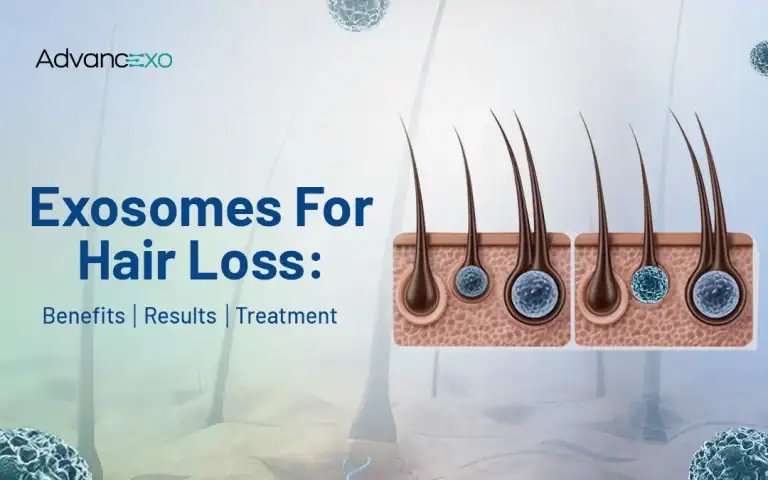
- Exosomes for Hair Loss interact with dormant hair follicles, activates body’s natural repair mechanism.
- Naturally diffuses through scalp tissues, pushing dormant hair follicles towards the anagen (growth) phase.
- Stimulates the hair follicle stem cells’ proliferation
- Increases follicular density, extends the anagen (growth) phase.
- Induces an anti-inflammatory response and an antioxidative effect
- Helps with immunomodulatory response, exosomes do not have DNA, lower risk of immune rejection.
Exosomes Treatment for Hair: How the Therapy Works
Exosomes for Hair Growth Involves a Cellular Mechanism
- Mechanism of action at the follicular level
- Exosomes for Hair Loss regulate intracellular signaling pathways of the hair cycle (Wnt/β-catenin, MAPK pathways)
- Restores metabolic activity in miniaturized hair follicles
- Boosts blood circulation, stimulates angiogenic factors
- Anti-inflammatory and antioxidant response supports normal follicle function
Activation of Dermal Papilla and Hair Follicle Stem Cells
- Stimulates dermal papilla cells, responsible for supporting hair growth
- Reactivates follicle stem cells, promotes entry to the growth phase.
- Upregulates the cellular proliferation and survival pathway
- Improves cellular coordination
Role of Growth Factors, miRNAs, and Cytokines
- Delivers growth factors (VEGF, IGF, FGF), nourishes hair follicles.
- microRNAs regulate gene expression, support cellular renewal
- Anti-inflammatory cytokines stabilize the scalp environment.
- Pro-regenerative signalling supports collagen synthesis and tissue repair.
5 Key Benefits of Exosomes for Hair Growth
Here are some facts that you must know before opting for Exosomes for Hair Growth
Stimulates Natural Hair Regrowth at the Cellular Level
- Reactivates dormant hair follicles. In pattern loss hair follicle gets trapped in the telogen phase.
- Exosomes deliver bioactive molecules, interact with dermal papilla cells and follicular stem cells.
- Activates cellular signalling pathways (Wnt/β-catenin, AKT, and ERK)
- Facilitates cellular communication between epithelial and mesenchymal cells
- Initiate new hair production.
Reduces Inflammation Linked to Hair Loss
- Chronic inflammation contributes to follicle miniaturization and premature Hair shedding
- Impaired Follicular stem cell response due to release of inflammatory cytokines (NF-α, IL-1β, and IL-6)
- Mesenchymal stem cells (MSCs) derived exosomes carry anti-inflammatory and antioxidant
- Activates pro-inflammatory pathway (NF-κB and MAPK)
- Enhances regulatory T-cell activities
- Balance scalp microenvironment, boost cellular regeneration
Improves Hair Density and Thickness
- Enhanced anagen prolongation in follicle cycling
- Exosomes release growth factors and microRNAs, regulates activity of keratinocytes and dermal papilla
- Signals mitochondrial activities, promotes protein synthesis, and follicular cell proliferation
- Follicles maintain longer growth cycles, resulting in thicker hair shafts
- Enhanced extracellular matrix remodeling, improve hair density
Enables Faster Recovery and Improves Scalp Health
- Exosomes Hair Regrowth Treatment combats mechanical stress, reduces blood supply in the scalp, and oxidative Damage
- Promotes tissue regeneration, activates fibroblasts, endothelial cells and keratinocytes (wound healing mechanism)
- Stimulates angiogenesis, improves blood supply in the scalp
- Improved vascularisation, increased delivery of oxygen, micronutrient delivery, and glucose
- Improved collagen synthesis, faster healing, and long-term scalp resilience.
Long-Lasting Results Compared to Conventional Treatments
- Exosomes alter gene expression patterns
- Promotes follicle self-renewal, reduces cellular senescence, resources cellular activity
- Integrates into the intercellular signalling network, working long after treatment cessation
- Produces long-term solution, minimal possibility of relapse
Exosomes for Hair Loss Before and After– What Changes Biologically?
- Improvement at the cellular and molecular level
- Natural Hair regrowth, progressive, visible result
- Address individuals’ specific factors, focus on the individual’s outcome
Who is the Ideal Candidate for Exosome Treatment for Hair?
- Individuals experiencing early to moderate hair loss
- Individuals experiencing genetic hair loss (Androgenetic alopecia) show pattern baldness
- Individuals have undergone hair transplantation
- Individuals seeking a non-invasive, natural solution to combat hair loss
- Finding a science-backed option, where all other conventional therapies have failed
How to Ensure the Safety Profile of Exosome Treatment for Hair?
- Research-backed evidence for the safety of Exosomes for Hair Growth
- Minimal downtime and side effects
- Some common side effects include scalp redness, occasional itching, mild localized swelling, and tenderness.
What are the Important Clinical Considerations?
- Individuals opting for Exosome therapy must consult an experienced dermatologist and a renowned clinic.
- The source of exosomes must be of superior quality
- Individuals opting for exosome treatment must clearly discuss their medical history, treatment procedure, potential risks, possible outcomes, and costs incurred before opting for treatment
*Advancexo, Noida, India, is one of the leading research laboratories that conducts cutting-edge research in exosomes and stem cells. The laboratory is GMP certified and manufactures superior quality exosomes for Hair and skin application.
Future of Exosomes for Hair Growth
- Long-term safety determination supported by a long-term clinical trial
- Personalized exosome formulations as per the patient’s need
- Evidence-based research on the expanding role in dermatology and trichology
Conclusion
Exosomes for hair growth are a modern regenerative solution. The hair growth occurs naturally and does not incur serious side effects with cosmetic treatments. Exosomes bring the changes from within and facilitate follicular regeneration.
Exosomes for hair growth occur progressively; do not expect magic instantly.
FAQ’s
Q- What are Exosomes?
Exosomes are Nano-sized biologics that are biologically active cargos. They consist of proteins, growth factors, and microRNAs. They are active molecules that have regenerative potentials.
Q- Are Exosomes for Hair Growth Safe?
Yes, exosomes for hair growth therapy are safe. They have minimal downtime and side effects. Some of the short-term effects include redness, localized inflammation, itching, etc. These effects go away in a few hours to a few days after the treatment.
Q- What are the Precautions After Exosome Therapy for Hair?
The precautions include avoiding direct sun exposure, performing intense physical activities, using a sauna, etc. One should not use harsh chemical-based hair products.