
A New Era of Hair Revival
Hair fall or ‘alopecia’ is no longer a permanent concern. Yes, you read that right. The shift towards regenerative aesthetics is a transforming approach to hair restoration.
Exosomes for Hair Regrowth aim to restore follicular function, improve scalp health, support natural hair growth, and promote long-term growth. Hair loss affects millions worldwide, increasing demand for effective hair loss treatment for men and women.
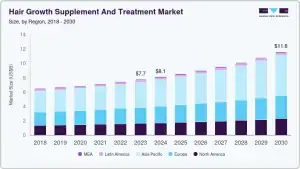
The global market offers a wide range of options. Currently, the estimated market size for hair growth treatments and supplements was 7.73 billion USD in 2023, and is projected to reach 11.58 billion USD by 2030 [1] (Figure 1). Dermatologists are seeking science-backed solutions that deliver real-time patient satisfaction.
Let’s explore where exosomes fit in the latest hair regrowth treatment landscape.
Understanding Hair Loss Beyond the Surface
Hair loss is a natural process for individuals with increasing age. Unregulated common triggers contributing to hair loss include:
- Hereditary Hair Loss/ Androgenetic Alopecia: The most common hair loss factor affects both men and women. Often termed as ‘male pattern’ or ‘female pattern’ hair loss. Inherited genes weaken hair follicles, leading to follicle shrinkage/miniaturization. It disrupts the normal hair growth cycle, leading to hair thinning or bald spots.
- Hormonal Imbalance: Mostly affects females suffering from polycystic ovary syndrome (PCOS). Other factors include the intake or halt of contraceptive hormonal pills, pregnancy cycle, etc.
- Autoimmune Factor/ Alopecia Areata: The body’s immune system attacks the hair follicle. It can occur in any part of the body (scalp, inside nose, ear, eyebrows, etc.). On the scalp, a patchy hair loss pattern appears.
- Scalp Infection: Results in scalp inflammation. Characterized by black spots/ dots in the scalp.
- Scalp Psoriasis: Chronic inflammation in the scalp area, resulting in a silvery scaly plaque appearance.
- Side Effects: Several medications, cancer treatments (chemotherapy or radiotherapy), and the use of cosmetic hair products, leading to allergic reactions.
Why Is Everyone Talking About Exosomes?
Exosomes are tiny biologically active molecules that act as ‘messenger bags’. These nano-sized molecules (30-150 nm) are packed with essential proteins, growth factors, cytokines, and microRNAs that boost cell-to-cell communication. They target the underlying cause of hair loss and modulate the repair mechanism, lower inflammation, and modulate the immune response.
Researchers have identified exosomes with tremendous therapeutic potential that support follicular rejuvenation and improve scalp health. Exosomes are recommended by dermatologists as the best hair regrowth treatment due to their natural ability to induce changes.
*Exosomes aren’t magic; it’s all science making changes from within.
How Exosomes Stimulate Hair Regrowth?
Mesenchymal stem cell (MSC)- derived exosomes have potential for advanced hair regrowth treatment. These molecules introduce multifold mechanisms to stimulate Hair Regeneration. The core mechanism includes:
- Hair Follicle Stimulation: Exosomes for hair regrowth stimulate the dermal papilla and activate hair follicle stem cells. It triggers the proliferative capacity of papilla cells. As a result, dormant hair follicles reactivate and boost entry to the anagen (growth) phase.
- Anti-Inflammation: Exosomes release anti-inflammatory molecules that combat scalp inflammation.
- Blood Circulation: Exosomes promote angiogenesis (release growth factors VEGF, IGF-1, or FGF). This promotes adequate blood, oxygen and nutrient supply to the hair follicles.
- Repair Mechanism: Exosomes support repair by promoting tissue regeneration. They extend the hair follicle anagen phase via modulating the signalling network (Wnt, β-catenin, etc.) [2].
Exosomes vs Conventional Hair Regrowth Treatments
Common conventional hair regrowth treatments include medications, platelet-rich plasma (PRP) treatment, and Hair transplantation. Then, what makes exosomes, the latest hair regrowth treatment, a popular choice for many patients is a common question. Here is what is available treatment for hair loss:
- Medications: Minoxidil, Finasteride, Spironolactone, etc.
- PRP: Use the patient’s own blood to gain concentrated platelets. PRP is injected into the scalp area affected by hair loss. The procedure requires frequent maintenance sessions.
- Hair Transplantation: A surgical procedure where a surgeon micrografts or minigrafts a hair patch at the balding area. The process is painful and requires sedation. The risk of bleeding, swelling, infection or bruising is higher.
*Exosomes for Hair Regrowth rewires the disrupted cellular signals from within. They are natural molecules that are safe and effective. Conventional treatment often requires a distinguished plan for hair regrowth treatment for men and hair regrowth treatment for women. Exosomes use a cutting-edge approach that is potentially effective in both men and women. Exosomes improve hair transplantation outcomes in patients with complete baldness.
The Treatment Experience: What to Expect
Exosomes for hair regrowth imply a step-by-step process. This includes:
- Pre-treatment Stage: Involves a detailed patient assessment, a holistic approach to understand the concern, the cause of hair loss, and determine the patient’s suitability.
- Treatment Stage: The dermatologist cleanses the affected area and administers a desirable concentration of exosomes. The effective administration method involves microneedling (which creates tiny punctures on the target scalp area), followed by exosome application.
- Post-Treatment Stage: Aftercare is crucial for the best outcome. Use dermatologist-recommended products, avoid direct sun exposure, and avoid strenuous activities for 48-72 hours. Significant reduction of hair shedding after 1-2 sessions. Visible improvement in hair growth after 2-3 months. Progressive development of hair thickness and quality by 5-6 months. The result lasts for 12-18 months or more, depending on the individual’s factors.
*NOTE: The number of sessions is recommended based on the patient’s response.
Is Exosome Therapy for Hair Loss Safe?
Scientific evidence indicates that Exosome Therapy is safe and effective in most cases. Clinical results revealed improved hair density, texture, thickness, and luster. It delivers long-term results. Understand that exosome therapy is new in the market. Don’t fall for big marketing claims like ‘miracle treatment’.
A Word of Caution
- Exosomes must be obtained from registered and qualified providers
- The batch test certificate, such as purity, cell viability, and sterility, must be available
- Always consult a qualified and experienced dermatologist
- Don’t fall for lower pricing; verify the legitimacy of the clinic
- Avoid treatments offered in the form of a subscription or claiming to deliver a ‘miracle solution’
- In future, there is a need to launch large-scale clinical trials to establish long-term safety and efficacy
*NOTE: Advancexo, India, is a leading company that supplies superior quality exosomes for hair regrowth. The product comes with a detailed safety certificate and user information.
Final Thoughts
- Exosomes for hair regrowth hold genuine potential in regenerative medicine.
- These tiny molecules regulate cellular behaviour, promote regeneration, induce repair mechanisms, and modulate immune function.
- Safe and suitable for individuals with sensitive or allergy-prone scalp.
- Make sound choices based on evidence-based information.
References
- Grand View Research. Hair growth supplement and treatment market size, share & trends analysis report, 2024–2030. San Francisco (CA): Grand View Research; 2024. Available from: Hair growth supplement and treatment market report
- Kost Y, Muskat A, Mhaimeed N, Nazarian RS, Kobets K. Exosome therapy in hair regeneration: a literature review of the evidence, challenges, and future opportunities. Journal of cosmetic dermatology. 2022 Aug;21(8):3226-31.
FAQs
Q- Is Exosome for Hair Growth an effective solution?
Yes, preclinical and clinical evidence have revealed the effectiveness of exosome therapy for hair growth. It leads to improvement of hair texture, density, and quality.
Q- Can other Hair Loss Treatments be combined with Exosome Therapy?
Yes, dermatologists recommend exosome therapy with other conventional hair loss treatments. It acts as a supportive approach that boosts hair regrowth.
Q- Can Exosomes revive dead hair follicles?
Exosomes stimulate dormant hair follicles. Complete death or loss of the hair follicle cannot be revived with exosomes. It is an extreme/ severe case of hair loss, and hair transplantation is the only solution.
Q- Are there any potential side effects of Exosome Therapy?
You won’t experience any major side effects with exosome therapy. Some short-term side effects include localized swelling, redness, or itching immediately after the treatment. This generally goes away in 1 week.

Pingback: Benefits of Exosomes for Hair: Hair Loss and Regrowth Guide
Pingback: Exosomes for Hair Regrowth in Pattern Baldness