AHair loss isn’t inevitable part of aging. It is medical conditions that require timely evaluation and evidence-based care. There are various causes of hair loss. Pattern baldness also known as androgenetic alopecia is among the most common causes that affect both men and women. The condition leads to the gradual miniaturization of the hair follicle. The conventional treatment primarily intends to slow down hair fall and preserve the existing hair. Regenerative dermatology shifts the treatment approach to the restoration of the hair follicle. The change is intended to occur at the cellular level.
Exosomes for Hair Growth are science-based approaches that aid in the activation of the dormant hair follicle in the case of shedding hair in case of pattern baldness. The article explores how exosomes for hair growth are redefining the future of hair restoration.
Why is Your Hair Thinning??
Pattern baldness is characterized by androgen-mediated baldness. It is a predetermined genetic condition that leads to progressive hair loss. The condition affects >50% of males and females. The condition comes with progressive terminal hair loss of the scalp anytime after puberty. Among males, the condition is commonly known as male-patterned baldness. The vertex and frontotemporal region of the scalp are affected. In females, the condition is called female-pattern baldness. The affected region is the frontal hairline, the hair sparsely grown on the crown and top of the head region.
Individuals with pattern baldness exhibit elevated levels of dihydrotestosterone (DHT), 5-alpha-reductase and abundant androgen receptors. Heightened androgenic milieu in the scalp leads to follicular miniaturization resulting in pattern thinning [1].
The Healthy Hair Growth Cycle Includes Four Phases:
- Anagen (growth) phase
- Catagen (involution) phase
- Telogen (resting) phase
- Exogen (shedding) phase
Among individuals with a healthy scalp, 80-90% of the hair remains in the anagen phase and has an average life span of 2-6 years. <5% of hair remains in the catagen phase, and the rest stands in the telogen phase. Shedding hair upto 100 hair stands everyday is normal.
What is the Root Cause of Hair Thinning in Pattern Baldness?
Hair Thinning Causes Include:
- Age: Patterned baldness affects both males and females. Among males, it is predominant. By the age of 50, 70% of men lose half of their hair
- Hormones: DHT binds to hair follicle receptors, leading to miniaturization
- Hair Cycle Alteration: Hair follicle miniaturization shrinks down the anagen phase and pushes the follicle into the telogen phase
- Chronic low-grade inflammation, oxidative stress
How Pattern Baldness is Treated?
A dermatologist evaluates medical history, conducts a physical examination of the scalp, and considers family history. Conventional Hair Regrowth Treatment includes:
- Medication: Minoxidil (Rogaine), Finasteride (Propecia). Medications can cause allergic reactions
- Hair Transplantation: Skin grafts from the healthy scalp area are transferred to the thinning area. Side effects include allergic reaction, vomiting, dizziness and scarring
- Platelet-Rich Plasma (PRP): The individual’s own blood is drawn and centrifuged. PRP is rich in growth factors. It is injected at the target site of the scalp. Individual’s health affects growth factor enrichment. Side effects include irritation, nausea and vomiting
*NOTE: The conventional hair regrowth treatment intends to slow hair thinning or shedding hair. It does not potentially alter the cellular network or rejuvenate hair
Can Hair Follicles Get Revived?
The concept of hair restoration sounds fascinating. In recent times, regenerative medicine is reshaping the therapeutic approach in the aesthetic industry.
It is a science-backed option. Dermatologists and researchers are relying on regenerative medicine in the aesthetic industry at present. Hair follicles remain biologically active even when they are miniaturized. Targeting the miniaturized follicle is the potential target. Dermatologists are relying on enhancing the scalp microenvironment and improving cellular communication to boost hair regrowth. Exosomes are naturally occurring bioactive molecules that stimulate cellular communication and boost repair mechanisms. Exosomes for hair growth have emerged as science-backed innovative solutions in aesthetic dermatology, where conventional hair regrowth treatment suffers.
What are Exosomes for Hair Growth
Cells secrete exosomes (tiny messenger) that carries various bioactive molecules. Exosomes are essential mediators of cellular communication. Researches use mesenchymal stem cells (MSCs)-derived exosomes to promote hair growth at the cellular level. The core mechanism involves:
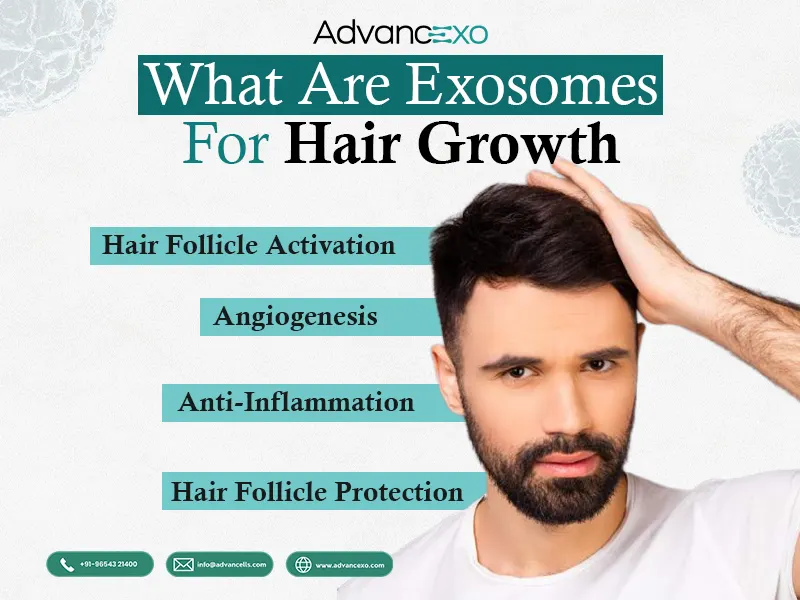
- Hair Follicle Activation: Exosomes stimulate dormant hair follicles at the telogen phase and push them towards the anagen phase. They boost cellular communication, activate and protect hair follicle stem cells
- Angiogenesis: Exosomes release various growth factors (VEGF, FGF, etc.). They promote new blood vessel growth and facilitate an adequate oxygen, nutrients, and blood supply in the scalp
- Anti-Inflammation: Exosomes release various anti-inflammatory molecules that neutralize the effect of pro-inflammatory signals. It modulates the immune response and creates a supportive scalp microenvironment
- Hair Follicle Protection: Exosomes release bioactive molecules, including proteins, microRNAs, cytokines and signalling molecules. It boosts cellular communication and stimulates repair mechanisms. They protect against cellular damage and promote hair regrowth.
Inside the Dermatologist’s Treatment Plan: Is Exosome Therapy Right for You?
The right candidate is a crucial aspect in the success of any therapy. Exosomes for Hair Regrowth Treatment is suitable for individuals including:
- Men and women experiencing excessive shedding hair (early to moderate stages)
- Individuals who want to opt for a preventive measure
- Combination therapy along with hair transplantation or PRP for a better outcome
- Individuals looking for a natural and non-invasive hair restoration solution
Exosome therapy is not suitable for individuals:
- Having active infection, seborrheic dermatitis, psoriasis
- Complete loss of hair follicle or scarring
- Candidates looking for a quick or overnight solution
From Consultation to Results: What to Expect?
Exosomes for hair growth works well with microneedling and topical massaging of the exosomes. It penetrates deeper and boosts cellular-level connection. The procedure involves:
- Consultation and Assessment: The dermatologist assesses the candidate’s detailed medical history, hair loss cause, severity, and family history
- Preparation: Superior-quality MSC-derived exosomes are procured for the treatment. The quality, isolation procedure, source, and quality checks all matter in gaining optimal outcomes
- Administration: Dermatologists perform outpatient procedures. The scalp is cleaned and local anesthesia is administered. Microneedling involves the creation of tiny controlled punctures at the target site, followed by topical application of exosomes
- Downtime: Normally, there is negligible downtime, and the candidate can resume their daily life activities soon after the procedure
- Aftercare: The dermatologist provides full accounts for aftercare. Avoid any strenuous activities (swimming, sauna or direct sun/heat exposure) for 48-72 hours,. Use mild products recommended by a dermatologist
- Side Effects: Normally, there are negligible side effects. Some short-term mild effects can include irritation, redness, localized swelling, tenderness, or itching. The side effects go away in a few hours to days. In case the problem persists, consult a dermatologist immediately
*Advancexo, India, is a renowned manufacturer of superior-quality clinical-grade exosomes for hair and skin rejuvenation. The product undergoes stringent quality checks and comes with a Certificate of Authenticity (CoA).
Choosing the Right Hair Restoration Expert
- Consult an experienced dermatologist and a renowned clinic before opting for hair regrowth treatment
- Pattern baldness is a progressive condition, and so is the response to exosome therapy. Don’t fall for scams or big claims promising an overnight quick solution
- The outcome varies among individuals. Factors influencing treatment outcome include Hair Thinning Causes, age, stage of hair loss, quality of exosomes and expertise of the dermatologist
Everything matters in the treatment’s success. Make your choice wisely.
Conclusion
Exosomes for Hair Growth are the future of hair rejuvenation. Early intervention produces better outcomes among candidates with pattern baldness. Dermatologists often develop personalized treatment plans based on an individual’s needs. A combination of exosome therapy and conventional hair regrowth treatment works efficiently. Making informed decisions based on evidence-based practice is crucial for optimal outcomes.
References
- Ho CH, Sood T, Zito PM. Androgenetic alopecia. InStatPearls [Internet] 2024 Jan 7. StatPearls Publishing.
FAQ’s
Q- What is Pattern Baldness?
Pattern baldness also known as androgenetic alopecia or hereditary hair loss occurs among both men and women. The condition occurs progressively. In males, the affects areas include vertex and frontotemporal regions. In females, the affected region are crown and top of the head regions.
Q- What are the Symptoms of Pattern Baldness?
Pattern baldness symptoms include gradual hair thinning on the crown or temples. Predictable changes in the hairline and scalp parting appear.
Q- What are the Hair Thinning Causes in Pattern Baldness?
Hair thinning causes in pattern baldness include age factors, hormonal fluctuation (DHT), chronic low-grade inflammation, oxidative stress, or hair follicle miniaturization.
Q- Is Exosome Therapy Effective for Pattern Baldness?
Clinical evidence supports exosome therapy against pattern baldness efficacy. The treatment outcome depends on the stage of hair thinning, severity, overall health, exosomes quality, administration procedures, aftercare etc.