
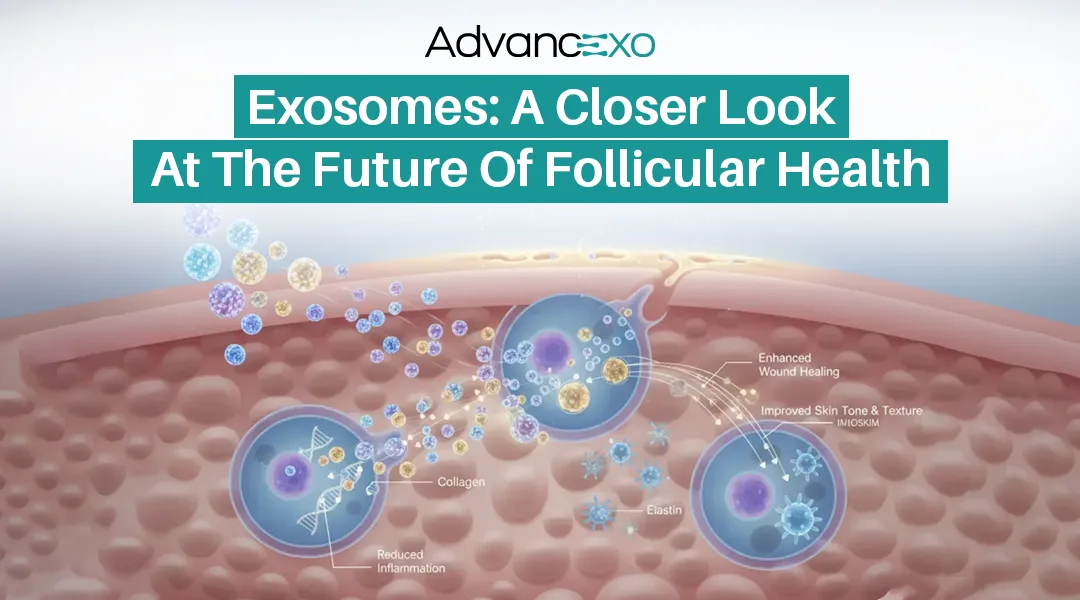
The next chapter of hair restoration begins at the microscopic level and involves understanding the changes at the cellular level.
Hair restoration has gradually moved beyond addressing hair loss symptoms. There is growing interest in understanding why follicles become less active, what influences the hair growth cycle, and how the scalp environment affects healthy hair growth. This has encouraged researchers to explore regenerative approaches, with Exosomes for Hair Growth emerging as an interesting area of investigation.
Exosomes are tiny, nano-sized extracellular vesicles with regenerative potential. They are described as a multiverse containing bioactive molecules (proteins, lipids, microRNAs, and signaling molecules). They boost cell-to-cell communication and coordinate different biological activities. In hair research, scientists are studying how these cellular messengers may influence dermal papilla cells, follicular stem cells, and signaling pathways involved in hair growth.
Currently, dermatologists and researchers widely explore Exosome Hair Treatment as an advanced aesthetic procedure. The core focus is on developing efficient formulations and delivery approaches, including topical applications and combinations with other procedures. The current article focuses on understanding the cellular mechanisms involved in exosomes for hair growth. It unveils possibilities for developing efficient formulations for the best outcome.
What Makes Exosomes Interesting for Hair Research?
Exosomes for hair loss are released by cells that have regenerative potential. Researchers widely use mesenchymal stem cell-derived exosomes for hair or skin rejuvenation. They efficiently deliver various bioactive molecules, including growth factors, microRNAs, cytokines, signalling molecules, and other molecules. They boost dormant hair follicles, improve blood circulation, reduce low-grade chronic inflammation, and modulate immune response. The delivery of the growth factors and cytokines efficiently repairs hair follicle damage and improves the scalp microenvironment.
What Causes Hair Loss?
Different Causes of Hair Loss Include:
- Androgenetic Alopecia: This is the most common cause of hair loss; results in patterned hair loss. Caused by genetic factors, mostly due to DHT overproduction. They bind to susceptible hair follicle receptors and shortens the anagen phase
- Alopecia Aerata: Autoimmune condition where the individual’s immune system treats hair follicles as foreign particles
- Telogen Effluvium: majority of the hair gets pushed towards the telogen phase. The anagen phase significantly shortens, leading to excessive hair shedding
- Hormonal Fluctuations: DHT, thyroid, cortisol, estrogen, progesterone, or insulin fluctuations imbalance various molecular pathways. They can potentially lead to hair follicle shrinkage and shorten the growth cycle
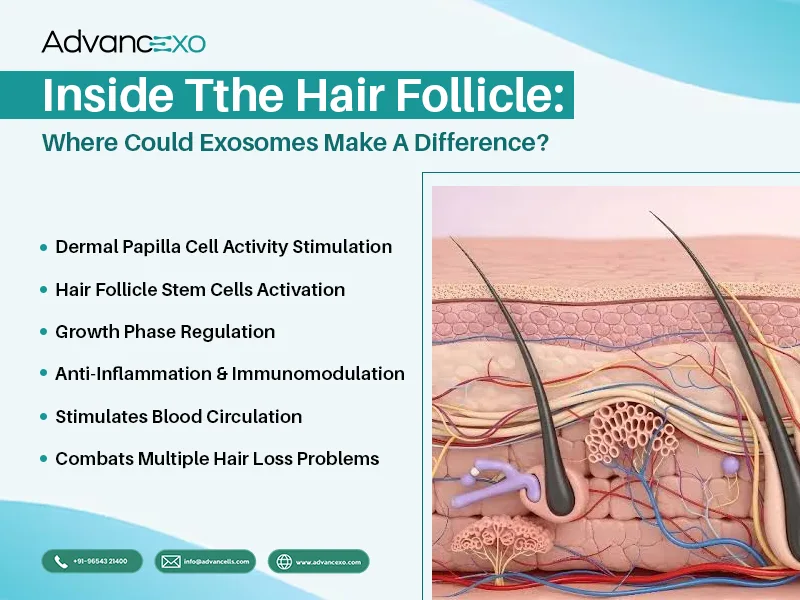
Inside the Hair Follicle: Where Could Exosomes Make a Difference?
Exosomes for Hair Growth Act at the Cellular Level. They Undertake Multiple Molecular Mechanisms Simultaneously. This Includes:
- Dermal Papilla Cell Activity Stimulation: Dermal papilla cells are responsible for regulating hair follicle growth and cycling. Exosomes stimulate dermal papilla activity and regulate the hair growth cycle
- Hair Follicle Stem Cells Activation: Exosomes release various growth factors and cytokines. They activate follicular stem cells and contribute to hair regrowth
- Growth Phase Regulation: Exosomes push hair follicles from telogen phase to anagen phase. They combat the problem of telogen effluvium (a condition where large numbers of hair follicles move to the telogen phase prematurely)
- Anti-Inflammation & Immunomodulation: Exosomes release various anti-inflammatory cytokines, combating the action of pro-inflammatory cytokines. It significantly reduces low-grade chronic inflammation. It modulates immune response and creates a calmer scalp microenvironment
- Stimulates Blood Circulation: Exosomes aid in the formation of tiny blood vessels. It enables adequate supply of nutrients, oxygen, and blood supply at the targeted scalp site
- Combats Multiple Hair Loss Problems: Exosomes simultaneously regulate various molecular mechanisms, including inflammation and immune response, boost repair mechanisms, and support regeneration
Exosome Hair Treatment: From Laboratory Research to Aesthetic Applications
Dermatologists globally have established collaborations with renowned research laboratories to procure clinical-grade exosomes for hair growth. The intent is to target the underlying cause rather than combating the symptoms. Hair Regrowth Treatments with exosomes are introduced as topical formulations or are combined with certain conventional approaches like PRP or microneedling. Current application strategies involve:
- Topical Application: Dermatologists massage the exosome formulation topically on the clean target site of the scalp
- Exosome with Microneedling: Microneedling creates micro-injuries on the target region. Exosome application post-microneedling enables deeper penetration
- Exosomes with PRP: Both exosomes and PRP involve regenerative approaches. However, their mechanism of action varies widely. For instance, in PRP, an individual’s own blood is drawn and centrifuged. They are introduced at the target site. PRP is rich in growth factors; however, the quality and concentration depend on the individual’s health. In contrast, exosomes are enriched with various bioactive molecules; they efficiently trigger molecular mechanisms and boost hair regrowth.
*NOTE: The overall outcome depends on various factors. This includes exosome quality, source, isolation procedure, administration process, and the individual’s suitability. Advancexo, India, is the leading manufacturer and supplier of clinical-grade exosomes for hair and skin rejuvenation. Exosomes are manufactured following the company’s internal standardised protocol and undergo stringent quality checks for every batch. The product comes with a Certificate of Authentication (CoA).
What Does Current Research Reveal About Exosomes for Hair Loss?
Preclinical and early clinical research reflected the positive outcomes of exosome hair treatment. The key highlights include:
- Improves scalp microenvironment and supports hair regrowth
- Reduces chronic low-grade inflammation around hair follicles
- Boosts repair mechanisms, reduces elevated levels of DHT hormones
- Combats autoimmune reactions and supports hair regrowth [1]
*NOTE: Currently, the effects of exosomes for hair loss are at an investigational stage. Future research focuses on launching well-structured large-scale clinical trials to establish long-term efficacy and safety of the treatment application. The focus remains on developing standardised protocols, source, concentration of the exosomes, etc.
What are Key Considerations Before Exploring Exosome Hair Treatment?
Dermatologists and individuals looking for advanced regenerative Exosome Hair Treatment must consider the following aspects:
- Product Characterisation: Identification of the exosome characteristics, quality, biomarker availability, and relevance
- Quality: Manufacturing standards, sterility, product purity, batch-to-batch consistency
- Suitability: Detailed assessment of the hair fall underlying cause. Determining an individual’s suitability for exosome application
- Expectation: Discuss realistic outcomes with the dermatologist. Exosome application isn’t a magic treatment. Do not expect an overnight outcome. The outcome depends on the product quality, underlying cause, hair loss severity, and individual’s response. The number of sessions depends on the individual’s response. Typically, individuals observe visible outcomes after 2-3
The Future of Exosomes for Hair Growth
Exosomes for hair growth are evolving as an advanced regenerative approach. They combat the underlying cause of hair fall and create a supportive scalp environment for hair growth. The combination of exosome hair treatment with conventional methods like microneedling boosts the procedural outcome. The choices must be based on dermatological guidance.
References
- Gupta AK, Wang T, Rapaport JA. Systematic review of exosome treatment in hair restoration: preliminary evidence, safety, and future directions. Journal of Cosmetic Dermatology. 2023 Sep;22(9):2424-33.
FAQ’s
Q- How do exosomes support hair growth?
Exosomes for hair regrowth treatment act as cargo. They carry various bioactive molecules like proteins, lipids, microRNAs, cytokines, and signalling molecules. They aid in cellular communication, modulate immune response, influence dermal papilla cells, activate follicular stem cells, and influence the hair growth cycle.
Q- Is exosome hair treatment effective for hair loss?
Preclinical and early clinical developments have shown a positive trend in exosome application efficacy in hair restoration. The outcome involved improvement in hair density, thickness, and follicular activity. However, the outcome varied among the individuals. Factors influence exosome formulation, delivery method, and the underlying cause of hair loss. More clinical studies are needed to establish the effectiveness and long-term outcomes of exosomes for hair loss.
Q- How is exosome hair treatment different from PRP?
PRP involves drawing blood from the individuals and centrifuges. PRP delivers growth factors and other signaling molecules at the target site. In contrast, exosome hair treatment introduces extracellular biological molecules that stimulate cell-to-cell communication. Both approaches are investigated for hair restoration, but they differ in their biological composition and mechanisms.
Q- Can exosome treatment combined with other hair regrowth treatments?
Yes, researchers are exploring exosome hair treatment in combination with approaches such as microneedling and other hair restoration procedures. However, the suitability of these combinations depends on the individual’s hair loss pattern, scalp condition, and treatment plan. A qualified professional should assess these factors before recommending an approach.


