Hair thinning is no longer viewed simply as a concern of hair loss. Currently, the concern has become an important part of the growing conversation around scalp health, hair density and aesthetic rejuvenation. With increasing interest in advanced hair regrowth treatment, researchers and dermatologists in aesthetic dermatology are exploring approaches that look beyond visible hair changes. The target is to understand the biological processes and underlying molecular mechanisms influencing follicular function.
Among the emerging developments, Exosomes for Hair Growth have attracted attention for their role in intercellular communication. These extracellular vesicles carry bioactive molecules, including proteins, lipids and regulatory RNAs. The molecules stimulate biological signals. Researchers are now investigating how this signalling activity could influence dermal papilla cells, hair follicle cycling and the scalp microenvironment. This interest has brought exosome hair treatment into the evolving landscape of regenerative aesthetics, particularly for individuals experiencing progressive hair thinning and reduced hair density. The early findings appear encouraging, yet the evidence related to clinical effectiveness and long-term outcomes is evolving. The current article focuses on understanding the science behind exosomes for hair growth in clinical and aesthetic contexts.
Understanding Hair Loss: What Happens at the Follicular Level?
Hair loss, or alopecia, is caused by disruption of the normal hair growth cycle. Normally, the hair growth cycle is categorised into four phases.
Normal Hair Cycle
- Anagen phase (growth phase) – Hair bulb divides rapidly, supporting new hair growth
- Catagen phase (transition phase) – Active growth phase halts; the hair follicle shrinks
- Telogen phase (resting phase): the hair rests inside the follicle; there is no new growth of the hair
- Exogen (shedding phase): Old hair falls out
*NOTE: Normally, shedding 50-100 hairs daily is part of the normal hair growth cycle. However, shedding more hair strands and a halt in subsequent hair regrowth results in a receding hairline, or baldness in the scalp.
Hair Loss Types
- Pattern Hair Loss: Androgenetic alopecia or patterned hair loss is the most common type of hair loss. Affects both males and females, caused by genetic cause
- Telogen Effluvium: Large number of hair follicles move towards the resting phase. There is less hair that enters the anagen phase. Various factors like thyroid condition, medical condition, certain medication, other hormonal imbalance, childbirth, etc. trigger hair loss
- Alopecia Areata: Autoimmune condition where the body’s own immune system attacks the healthy hair follicles as foreign particles. Generally, the hair follicle falls out in small patches, while for many individuals, all the hair falls out
- Anagen Effluvium: Rapid hair loss due to certain medical procedures like chemotherapy. The medication’s action destroys the hair follicle
- Traction Alopecia: Certain tight hairstyles or use of harsh chemical products for hair styling affects hair growth
*NOTE: Dermatologists assess an individual’s causes of hair fall to determine suitable hair regrowth treatment.
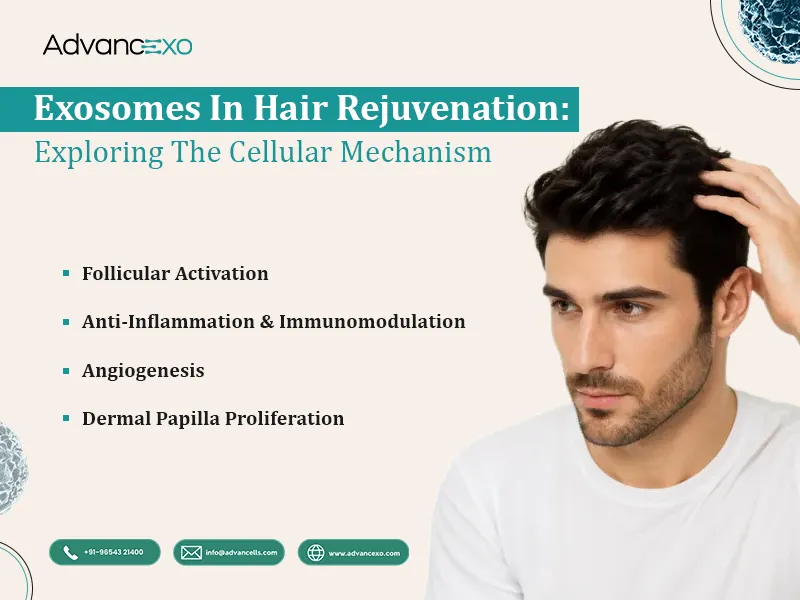
Exosomes in Hair Rejuvenation: Exploring the Cellular Mechanism
Exosomes are evolving as an Advanced Hair Regrowth Treatment approach. Exosome are nano-sized extracellular vesicles (30-150 nm) that facilitate cellular communication. Researchers widely explore exosomes derived from mesenchymal stem cells (MSCs) for hair regrowth treatment. They act as cargo that carries multiple bioactive molecules like proteins, microRNAs, cytokines, growth factors, and other signalling molecules.
Exosomes for hair growth influence changes at the cellular level. The key mechanism includes:
Follicular Activation
- Exosomes release various signalling molecules
- They stimulate follicular signalling and activate hair follicle stem cells
- Hair follicles stuck at the telogen phase transition into the anagen phase
Anti-Inflammation and Immunomodulation
- Exosomes deliver various anti-inflammatory cytokines (IL-10, TGF-β)
- They combat the action of pro-inflammatory cytokines
- Calms the chronic low-grade inflammation surrounding hair follicles
- Modulates immune response and prevents immune cell action against hair follicles
Angiogenesis
- Exosomes in hair regrowth treatment release various growth factors (VEGF, FGFs)
- They support formation of tiny blood vessels around the hair roots
- Supports adequate blood, nutrient, and oxygen supply
Dermal Papilla Proliferation
- Stimulates developmental pathways (WNT/β-catenin)
- Upregulates action of transcription factors (LEF-1)
- Supports dermal papilla proliferation and follicular stem cells [1]
How do Exosomes for Hair Regrowth Treatment Work?
Exosomes are considered the Latest Hair Regrowth Treatment. The hair regrowth outcome occurs gradually. The process involves:
- 2-4 weeks: Scalp relaxes and gets healthier. There is an intrinsic increase in blood circulation
- 6-8 weeks: Visible changes in the hair regrowth. The hair thinning strands become thicker, the hair becomes shinier and grows longer
- 3-6 months: Hair loss is significantly reduced. Noticeable increase in hair density, growth in new hair strands, improved hair circulation
*NOTE: Exosome hair regrowth outcomes vary among individuals. The overall outcome depends on the underlying cause of the hair loss, individual’s factors, quality of the exosomes, source, concentration of bioactive molecules, and administration procedure. It is crucial to choose superior quality exosomes. Advancexo, India, is a leading manufacturer and supplier of clinical-grade exosomes for hair and skin rejuvenation. The product comes with a Certificate of Authentication (CoA).
Exosome Hair Treatment vs Conventional Hair Regrowth Approaches
Dermatologists assess the underlying cause of the hair loss and determine adequate hair regrowth treatment. Various hair treatment approaches include:
| Approaches | Focus |
| Minoxidil | Support hair growth, clams inflammation and prolong anagen phase |
| Finasteride | Modulates androgen-associated hair follicle miniaturisation |
| PRP | Blood drawn from individual’s body, the blood is centrifuged and PRP consisting of rich growth factor and signalling molecules stimulates hair growth |
| Hair Transplantation | Redistribution of the hair follicles at the affected area |
| Exosomes | Latest hair regrowth treatment that introduce regenerative signalling, support repair mechanism and boost follicular activities |
*NOTE: Dermatologists often combine conventional hair regrowth approaches with exosome hair treatment.
What are the Key Considerations Before and After Exosomes Hair Treatment?
The outcome of exosomes for hair growth requires routine care. The key considerations involve:
- Avoid alcohol consumption or smoking
- Stop using any harsh chemical products on the scalp
- Maintain hair cleansing; use dermatologist-recommended gentle products
- Avoid prolonged exposure to direct sun or heat exposure
- Based on the individual’s response, the dermatologist recommends the desired number of sessions
Conclusion
Exosomes are advanced hair regrowth treatment approaches. They target the underlying cause of hair fall rather than just addressing the symptoms. The modulation of the cellular or molecular mechanism potentially introduces changes for a longer time. One considering exosome hair treatment must consult an experienced dermatologist and a renowned clinic to determine treatment suitability. Future research focuses on launching well-structured large-scale clinical trials to establish long-term treatment outcomes.
References
- Cheng M, Ma C, Chen HD, Wu Y, Xu XG. The roles of exosomes in regulating hair follicle growth. Clinical, Cosmetic and Investigational Dermatology. 2024 Dec 31:1603-12.
FAQ’s
Q- Can exosomes help with thinning hair and hair regrowth?
Exosomes are being studied for their ability to support communication between cells involved in hair follicle function. Early research suggests that they could influence pathways associated with follicular activity and the hair growth cycle. However, their ability to produce visible and consistent hair regrowth in humans is still being investigated.
Q- How is exosome hair treatment different from PRP?
PRP uses platelet-derived growth factors obtained from the individual’s blood, while exosomes are extracellular vesicles that carry proteins, lipids and regulatory molecules involved in cellular communication. Both approaches have attracted interest in hair rejuvenation, but they work through different biological mechanisms.
Q- Who can consider exosome-based hair treatment?
People experiencing early-stage hair thinning or reduced hair density may be interested in exploring exosome-based approaches. However, hair loss can have several underlying causes, including hormonal changes, genetics and nutritional deficiencies. Dermatologists identify the cause and determine which hair regrowth treatment is appropriate.
Q- Can exosome hair treatment restore hair density permanently?
Exosomes have shown promising potential in early hair research, particularly in relation to cellular signalling and hair follicle activity. However, current clinical evidence does not establish permanent hair restoration. More human studies are needed to understand how long the results last and which individuals are most likely to benefit.