
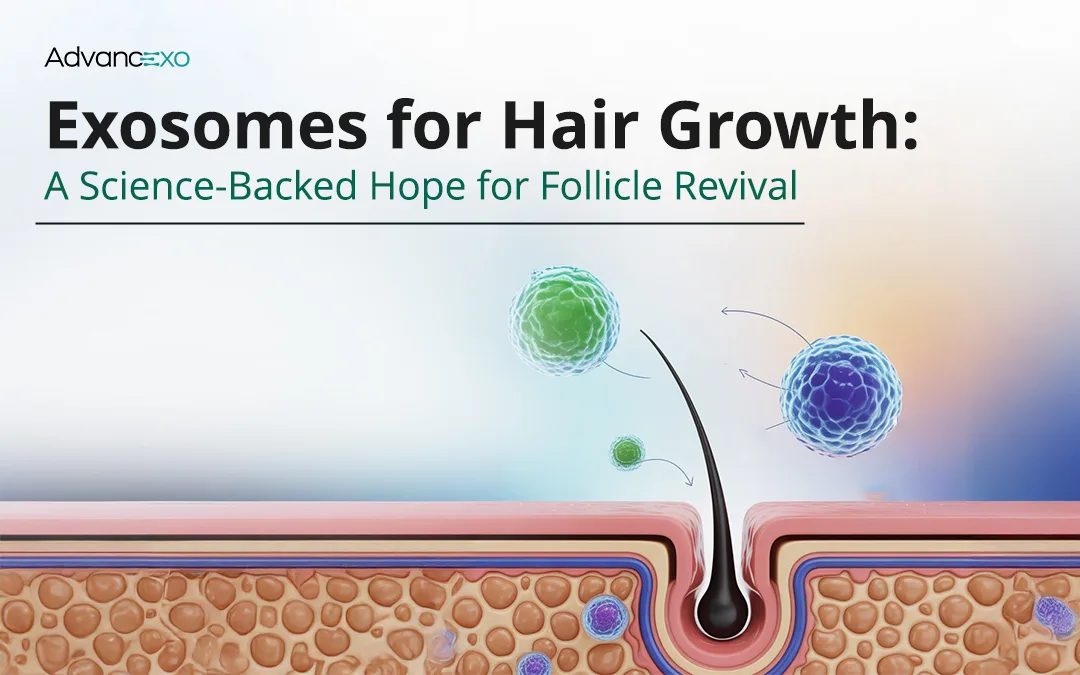
Science Behind Exosomes for Hair Growth
Autoimmune-driven hair loss can feel irreversible. What if micro-messengers are turning into a science-backed solutions?
Autoimmune hair loss or ‘Alopecia Areata’ is the condition where the body’s immune system attacks one’s hair follicles. This leads to patchy hair loss. There is significant high psychological burden of hair loss. Medications and therapies might help with hair regrowth. In severe cases, nothing might work.
Tiny messengers called ‘Exosomes’ are new science-backed solutions that have brought revolution in Hair Regrowth Treatment. Exosomes carry various growth factors and proteins that trigger dormant hair follicles and boost hair growth.
For a better understanding of how these tiny molecules do wonders, let’s gain a clear understanding of autoimmune hair loss and how exosomes stimulate dormant hair follicles.
Understanding Autoimmune Hair Loss
Alopecia areata is an autoimmune condition that can affect any part of the body, leading to patchy loss of hair. The most commonly affected body part is the scalp, the skin that covers the head. The different forms of alopecia areata includes:
- Alopecia areata totalis: Complete loss of scalp hair
- Alopecia areata universalis: Complete loss of hair from the scalp and all over the body
- Diffuse alopecia areata: Hair thinning occurs, complete fall in patches does not appear
- Ophiasis alopecia areata: Loss of band of hair from the back or bottom side of the scalp
Who is Affected by Alopecia Areata?
Every individual can develop alopecia areata. The individuals who are at a higher risk include:
- Children
- Family history of alopecia areata
- Family history of autoimmune disorders like lupus, diabetes or thyroid
How is Alopecia Areata Treated?
There are several treatment options recommended by a dermatologist, this includes:
- Medications: Anti-inflammatory drugs like corticosteroids injected on the scalp or orally prescribed
- Topical medication: Minoxidil is recommended for topical application
- Phototherapy: Ultraviolet light used for the introduction of drugs like psoralen, combined with Ultraviolet A and Ultraviolet B
- Platelet-rich plasma: Blood is taken from the body followed by processing, and injected into the scalp to stimulate hair growth
- Topical Immunotherapy: Here, the dermatologist rubs allergens on the scalp, creating an allergic reacting, triggering hair growth
The above treatments are associated with specific side effects:
- Scalp irritation
- Lymphadenopathy (swollen lymph nodes)
- Skin discoloration
- Eczema
Exosomes Hair Treatment
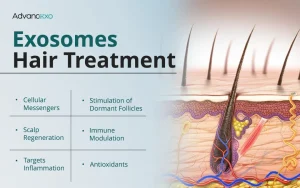
Exosome for hair loss have gained immense medical attention. They posses rejuvenating ability. They deliver intrinsic signals that promote hair regrowth by stimulating dormant hair follicles.
The mechanism includes:
- Cellular Messengers: Tiny messengers are nano-vesicles that carry microRNA, growth factors (cytokines & chemokines), and proteins
- Stimulation of Dormant Follicles: Exosome delivers growth signals to miniaturized hair and dormant hair follicles. It activates them to enter the growth phase.
- Scalp Regeneration: Exosome hair treatment promotes cell proliferation, reduces inflammation, and enhances blood flow. This create a healthier microenvironment for hair growth.
- Immune Modulation: Exosomes possess the ability to reprogram immune cells, like increasing T-regulatory cells, and reduce inflammation. It prevents autoimmune attacks
- Targets Inflammation: Exosomes decrease pro-inflammatory modulators like interleukin-6 and tumour necrosis factor-α and increase the level of anti-inflammatory molecules (IL-10)
- Antioxidants: Exosomes possess an anti-inflammatory effect and release antioxidants. Inflammation and hair radicle damage (action of free radicals) reduces.
Scientific Evidences and Research
Exosomes for Hair Growth have significant positive outcomes in increasing hair growth and improving dermal thickness. The research insights includes:
Preclinical & Clinical Insights
- Most favourable effects were found with exosomes derived from mesenchymal stem cells (MSCs)
- Introduced paracrine regulation of dermal papilla cells
- Facilitates cross-talk between cells (cell-to-cell communication)
- Upregulates hair growth, promoting miRNA expression, e.g, miR-181a-5p, miR-218-5p
- Inhibits the expression of miR-22-5p, which restricts hair growth
Case Study: Exosomes for Hair Loss
Exosome Hair Regrowth Treatment case studies include:
1. Case series (39 AGA patients):
- Weekly topical ADSC-derived exosomes with microneedling for 12 weeks
- Significant improvements in:
- Hair density (↑ from 121.7 to 146.6 hairs/cm²)
- Hair thickness (↑ from 52.6 μm to 61.4 μm)
2. Biologic injections containing extracellular vesicles (EVs):
- 64.5% of patients reported visible hair growth
- Hair density increased by 11–24%
3. Ongoing clinical trial (NCT05658094): amniotic mesenchymal stem cells-derived exosomes in alopecia patients.
Limitations: Most studies lack control groups, making spontaneous regrowth difficult to exclude.
Exosome Hair Treatment: Procedure and Application
Exosome Hair Regrowth Treatment steps include:
- Detailed assessment of the patient’s problem
- Assessing detailed medical history
- Extraction of exosomes from MSCs
- Testing the quality and safety of the exosomes, consisting of essential proteins, messenger RNA, cytokines, etc.
- Scalp Numbing: Area where exosome is applied
- Administration: Route of administration include microneedling, topic application or injection, depending on the patient’s need
- Post-treatment care instructions- avoid washing of hair with shampoo consisting of harsh chemicals or direct sun exposure for 24 to 48 hours
Exosomes Hair Treatment vs Traditional Hair Regrowth Treatments
-
Exosome vs. PRP therapy
PRP uses the patient’s own blood and is introduced at the site of hair thinning. PRP’s effect highly depends on the patient’s own body condition. Exosome therapy introduces growth factors, RNAs, essential proteins, etc., that revive the dormant hair follicles. Exosome therapy is more potent and targeted.
-
Exosome Therapy vs. Medications/Topical Treatments
Oral medications or topical treatments require long-term usage. The results with medication fades after the course. In exosome therapy, the noticeable result is long-term and effective with 1-3 sessions of application.
Benefits of Exosomes for Hair Loss
- Non-surgical and minimally invasive approach
- Potential for long-term follicle health
- Suitable for autoimmune-related hair loss
Safety
Research has reported minimal serious events with Exosome Hair Treatment.
Common side effects include:
- Mild effects (erythema, oedema, dryness, pain)
- Average downtime ~4 days
- Mild hyperpigmentation
- Fever, fatigue, infection, or systemic reactions
Recommendation
The widespread clinical adoption require controlled clinical trials and long-term safety studies.
Who is the Ideal Candidate for Exosome Hair Treatment?
- Patients of all ages and genders
- An individual experiencing early to moderate hair loss
- An individual showing non-scarring autoimmune hair loss
*NOTE: Exosome hair treatment works best when the hair follicles are still alive or in a dormant stage. Superior exosome quality is desirable
Advancexo is one of the leading research laboratories in India that is dedicated to cutting-edge exosome research and innovation.
Contact Us
Major Takeaways
- Exosomes therapy is a next-generation hair regrowth treatment
- Revives dormant hair follicles and modulates immune response
- Regulates inflammation, promotes regeneration and improves blood supply in the scalp
- Safe and long-term solution for hair regrowth treatment
FAQ’s
Q- Is alopecia areata contagious?
No, alopecia areata isn’t contagious. It is a common myth among people that alopecia areata can spread through skin-to-skin contact.
Q- Can alopecia areata curable?
No, alopecia areata does not go away completely. Medications and other treatments help in managing the hair loss and slow it down.
Q- How does exosome therapy help with hair regrowth?
Exosomes are tiny vesicles consisting of essential proteins, nucleic acids, growth factors, etc. The introduction of exosomes helps in the revival of dormant hair follicles.
Q- Is exosome therapy a solution for all forms of autoimmune hair loss?
Exosome therapy is most effective with non-scarring autoimmune hair loss where hair follicles are in dormant stage. The presence of severe autoimmune hair loss or scarring, hair transplantation is recommended.

The emotional burden of Alopecia Areata can be just as challenging as the physical symptoms, so it’s great to hear about emerging treatments like exosomes. It’s interesting to think about how these micro-messengers could provide a new approach to stimulate hair growth when traditional methods haven’t worked.
Exosome therapy for Alopecia Areata has an advantage over traditional therapy as it modulates the immune response from the inside. Exosomes carry essential proteins, microRNAs, and growth factors that stimulate the dormant hair follicles, triggering them to enter anagen (growth phase), hence helping with hair regrowth. The sessions required for exosome therapy might vary depending on the specific condition of the patient. Generally, after 1-3 sessions, visible changes are seen with improved hair growth and hair texture. However, the patients experiencing complete scarring where the hair follicles are dead, exosome therapy might not work.
Thank you for reaching us. For detailed information please discuss the problem and find the best solution for your problem. Please reach us out at https://advancexo.com/, or, Call us- +91-9654321400 Our Office Address: 1st Floor, A-102, Block A, Sector 5,Noida, Uttar Pradesh – 201301
An excellent overview of the science behind exosomes and their role in autoimmune-related hair loss like alopecia areata. The way exosomes modulate inflammation, stimulate dormant follicles, and support immune balance makes them a promising regenerative option when conventional treatments fall short. Advanced clinics such as Maynee Cosmetology Clinic, Madurai are now integrating evidence-based therapies like exosome treatment, PRP, and microneedling to offer personalised solutions for non-scarring hair loss. Continued research and proper patient selection will be key to long-term success.
We’re happy that you love our content. Thank you for reaching out to us. Please contact us via WhatsApp or call us at +91-9654321400, or mail us on info@advancells.com for more information. We’re here to support you every step of the way.