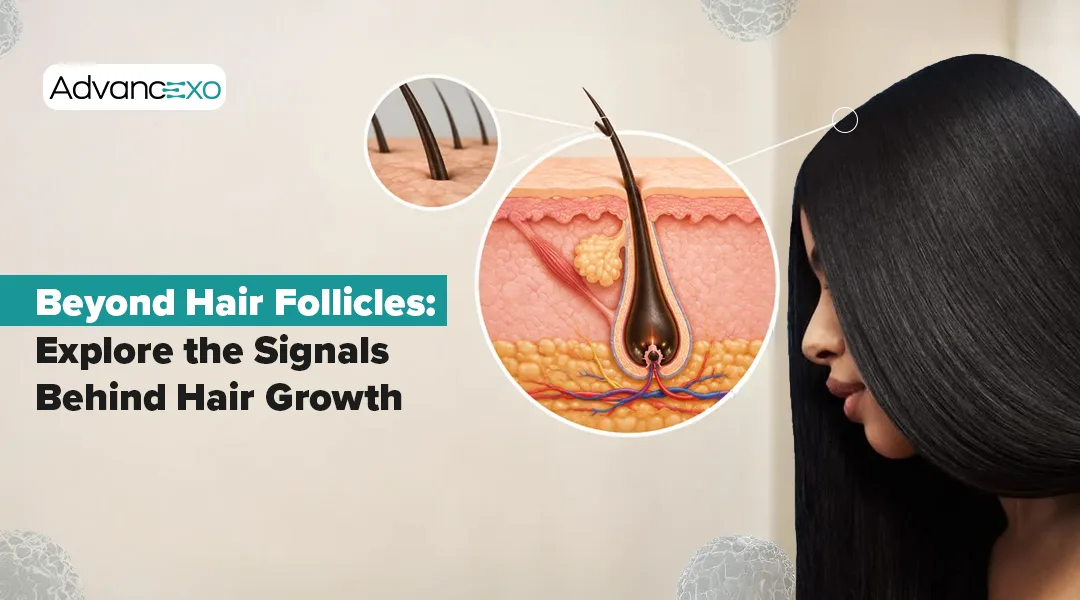
Beyond stimulating hair growth, researchers are asking a different question: Does the conversation around hair growth begin at the cellular level?
In recent times, hair growth is no longer viewed through the lens of growth stimulant availability. Researchers and dermatologists have shifted their interest towards cellular signals that shape the follicular microenvironment. Exosomes for Hair Growth have emerged as a regenerative solution that addresses the hair loss problem at the cellular level. These tiny vesicles stimulate cellular communication, cell survival, and inflammation and create a healthier scalp microenvironment.
In the context of hair biology, researchers are actively exploring how the signals support dermal papilla, follicular behaviour, and hair growth. This places exosomes at the intersecting junction of regenerative medicine and aesthetic dermatology. The current article explores the evolving landscape of exosomes in hair rejuvenation.
Exosomes And The Biology Of The Hair Growth Cycle
Hair Growth Follows a Continuous Cycle. Follicular Activities are Affected by Adequate Balance Between the Hair Growth Phases. The Primary Phase Includes:
- Anagen (Growth Phase): Hair follicles are at active phase; they promote hair shaft growth. The phase supports rapid cellular proliferation and metabolic activities. The hair follicle majorly remains at anagen phase. However, premature hair loss pushes the hair follicle towards telogen phase abruptly
- Catagen (Transition) Phase: The follicular activity decreases gradually. Follicles undergo controlled regression. The disruption of the transition phase adversely affects normal hair cycle progression.
- Telogen (Resting) Phase: The follicle enters an inactive state. Prolonged telogen phase produces visible signs of hair thinning or reduced hair density.
Now the question arises: How do exosomes fit into the picture?
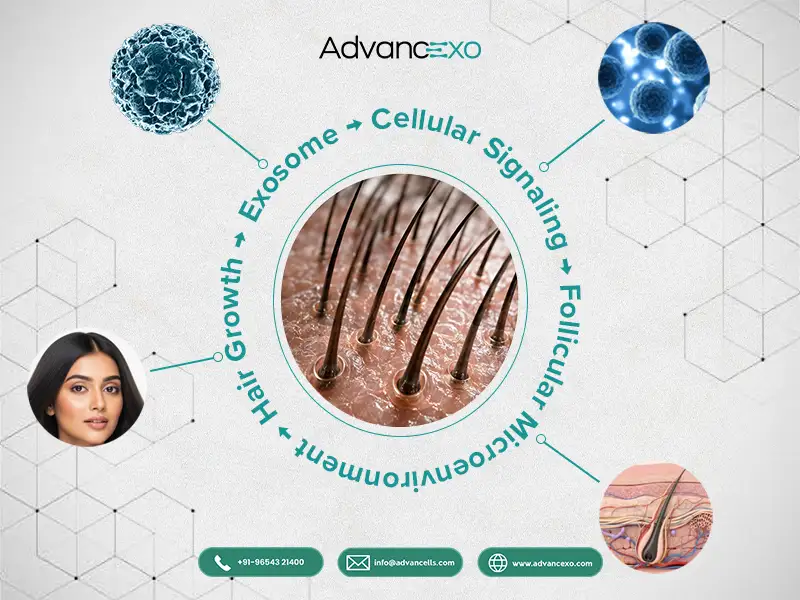
Exosome-mediated signalling influences cellular activities and the scalp microenvironment. They regulate follicular cycling, stimulate dermal papilla function and boost repair mechanisms. Exosomes for Hair Restoration potentially modulate biological signals to support follicular cycling.
How Does Exosome Signaling Influence the Hair Follicle?
Exosomes are extracellular components secreted by cells that possess regenerative potential. These are nano-sized vesicles (30-150 nm) that act as messenger bags. They carry various bioactive molecules (proteins, microRNAs, cytokines, growth factors, lipids) that potentially influence cellular processes. Researchers are widely exploring mesenchymal stem cell (MSCs) derived exosomes for hair and skin rejuvenation.
Exosomes for Hair Growth Undertake the Following Possible Mechanisms:
Hair Follicle Activation
- Exosomes release several growth factors and cytokines
- Stimulates dormant hair follicles and pushes them towards anagen (growth) phase
- Boosts proliferative capacity of the hair follicles
- Creates a protective environment for hair follicle stem cells
- Protects follicle from oxidative stress and apoptosis, maintains follicular regenerative capacity
Anti-Inflammation & Immunomodulation
- Exosomes for hair loss release anti-inflammatory molecules (TGF-β, IL-10, miR-146a, miR181a)
- Combats pro-inflammatory signals
- Reduces inflammation around the hair follicle
- Modulates immune responses, autoimmune reactions
- Creates a calmer scalp microenvironment, supports follicular health
Angiogenesis
- MSCs-derived exosomes actively release growth factors (VEGFs, FGFs)
- Promotes vascularization via tiny blood vessel formation
- Boost blood, oxygen and nutritional flow in the scalp
- Nourished hair follicles support hair growth eventually
Hair Cycle Regulation
- Exosomes for hair growth regulate hair growth cycle
- Boosts new hair growth; declines hair loss rate
- Modulates signalling network, prolongs anagen phase
- Delays catagen (resting) phase [1, 2]
What Does the Current Evidence on Exosomes for Hair Loss Show?
Currently, the evidence related to exosomes for hair loss is still evolving. Preclinical and clinical evidence highlights a positive trend in introducing Exosome Treatment for Hair Growth. The key indications include:
- Hair Density: Visible growth in hair density. Decrease in hairline
- Improvement in Hair Shaft Thickness: Improvement in the hair diameter, combats follicular miniaturization
- Follicular Characteristics: Changes in follicular activities, improvement in markers related to dermal papilla
- Improved Hair Health: Decrease in hair fall intensity, growth in baby hair, decrease in hairline
Why the Approach Matters: From Exosome Preparation to Delivery
Exosome Treatment for Hair Loss has displayed a distinct outcome across the candidates. Factors including treatment suitability and exosome quality influence the treatment outcome. The key considerations for dermatologists include:
Key Considerations While Choosing Exosomes
- Exosome source
- Isolation & purification procedure
- Exosome characterization
- Maintenance in consistency with each batch of production
- Availability of the concentrated bioactive molecules
- Administration protocol
- Dosage and number of sessions required
Ideal Candidate Consideration
- Individuals with patterned hair loss (androgenetic alopecia)
- Individuals at early to moderate stage of autoimmune hair loss (alopecia areata)
- Candidates who have failed conventional treatment options (minoxidil, corticosteroid, finasteride)
- Individuals seeking a non-surgical and more natural option
- Candidates with overall good health (no active infection or existing chronic condition)
*NOTE: MSC-derived exosomes are suitable for hair loss. However, the decision should be made after strict evaluation of the hair loss cause and detailed consultation. The exosome must be of superior quality. Advancexo, India, is a leading supplier of clinical-grade exosomes for hair and skin rejuvenation. The product is provided with Certificate of Authenticity (CoA). A dermatologist develops a personalized treatment approach based on the individual’s needs
Where Exosome-Based Approaches Fit in Hair Loss Management?
- Exosomes for hair growth are an evolving regenerative approach
- One size doesn’t fit all. A dermatologist develops a personalized treatment plan based on the individual’s needs
- A combination of conventional approaches or other hair treatment procedures (PRP, microneedling, etc.) develops long-term positive outcomes
- Exosome treatment for hair loss uses cell-free bioactive vesicles; the possibility of immune rejection is minimal
- The outcome depends on hair loss causes
- Exosome Treatment for hair growth requires large-scale clinical trial outcomes to establish the safety and efficacy of the treatment
The Future of Exosomes for Hair Growth
In current aesthetic dermatology, both researchers and dermatologists are shifting their interest to incorporate exosomes for hair growth. Clinical-grade, well-characterized exosomes must be used for hair rejuvenation. The future studies should focus on process optimization, dosage, efficient delivery approaches and defining p[atient se; lection criteria. Larger clinical trials are crucial to determine long-term safety and efficacy of the approach.
References
- Vyas KS, Kaufman J, Munavalli GS, Robertson K, Behfar A, Wyles SP. Exosomes: the latest in regenerative aesthetics. Regenerative medicine. 2023 Feb 1;18(2):181-94.
- Shah M, Dukharan V, Broughton L, Stegura C, Schur N, Samman L, Garcia‐Meraz C, Macaraeg‐Jimenez JL, Belo VG, Majewska L, Valle RG. Exosomes for aesthetic dermatology: A comprehensive literature review and update. Journal of Cosmetic Dermatology. 2025 Jan;24(1):e16766.
FAQ’s
Q- How are Exosomes Studied for Hair Growth?
Exosomes for hair growth evolve as a regenerative approach. Exosomes carry various bioactive molecules that can modulate cellular signals. They stimulate dormant hair follicles and push them towards the anagen (growth) phase. It promotes hair regrowth.
Q- What Hair Loss Types Can Use Exosomes?
Exosome treatments for hair loss are suitable for various hair fall indications. This includes alopecia areata, androgenetic alopecias, hormonal hair loss, telogen effluvium, etc. The suitability of the treatment is determined by the dermatologist after a detailed candidate assessment.
Q- Are Exosomes an Established Treatment for Hair Loss?
No, exosomes are still an evolving area of hair rejuvenation approach. Preclinical and early clinical studies have indicated positive trends in hair regrowth. The studies reflected negligible side effects and long-term efficacy.
Q- What Should Dermatologists Consider?
Dermatologists must consider exosome quality, source, characterization, isolation procedure, candidates’ suitability, administration procedure, etc. while considering exosomes for Hair Restoration. Based on the individual’s need, the treatment process is personalized.