
Hair loss doesn’t begin with losing hair strands. The actual problem begins far before the visible signs appear. The hair follicle eventually gets miniaturized, which deteriorates hair quality. Various factors, including genetic, environmental, endocrine, or psychological factors, can lead to increased hair fall. As part of aesthetic hair care, the approach is moving away from conventional approaches. The attention is paid more towards changes in the scalp’s biological environment rather than focusing on the visible signs of hair loss.
Exosomes for hair loss are an emerging regenerative approach that targets the underlying cause of excessive hair loss. They potentially regulate cellular signalling, target low-grade chronic inflammation and create a supportive scalp microenvironment. This has created immense interest among researchers and clinicians towards exosome hair treatment as part of the modern-day hair restoration approach. The current article explores the scientific rationale towards introducing Exosomes for Hair Loss as part of a regenerative aesthetic approach.
What is the Correlation Between Hair Growth Cycle and Hair Fall?
Losing 50-100 hair strands regularly is normal. However, losing more than that is a matter of concern. This can be better explained by understanding the hair growth cycle. Hair growth is distinguished by four distinct stages, including:
- Anagen Phase (Growth): This is the longest phase (2-8 years). The hair follicles are in active form and push hair out actively. The hair continues to grow until it is cut or falls out naturally. At this time, 80-90% of the hair remains in the anagen phase
- Catagen Phase (Transition): This lasts for approximately 2 weeks. The hair follicle shrinks, and hair separates from the bottom of the hair follicle. Approximately 1-3% of the hair remains in this phase
- Telogen Phase (Resting): The phase typically lasts between 2 to 3 months. Approximately 9% of the hair remains in this phase. The hair does not fall out but prepares itself for shedding. In altered conditions, the hair from the anagen phase is pushed towards the telogen phase (telogen effluvium). The hair fall rate increases significantly, and the new hair does not grow at the same pace
- Exogen Phase (Shedding): Last phase where the hair falls out of the scalp. Normally, the older hair falls out while the new hair grows from the follicle.
How Do Exosomes Target Hair Loss?
Exosomes are biologically active cargoes that are released by cells. Researchers are widely using exosomes derived from mesenchymal stem cells (MSCs) for hair and skin rejuvenation. Exosomes for Hair Loss are microscopic extracellular vesicles that appear as tiny sacs bound by membranes. They act as an active messenger that carry proteins, growth factors, cytokines, microRNAs, and other signalling molecules. The introduction of exosomes for Hair Regrowth Treatment boosts cell-to-cell communication and regular cellular signals. They boost hair follicle stem cells, stimulate intrinsic repair mechanisms, and aid in hair regeneration. They deliver growth factors and cytokines that create a supportive scalp microenvironment.
How Do Exosomes Support Hair Regrowth?
Exosomes for Hair Loss have a Multifactorial Role. The Key Mechanisms Include:
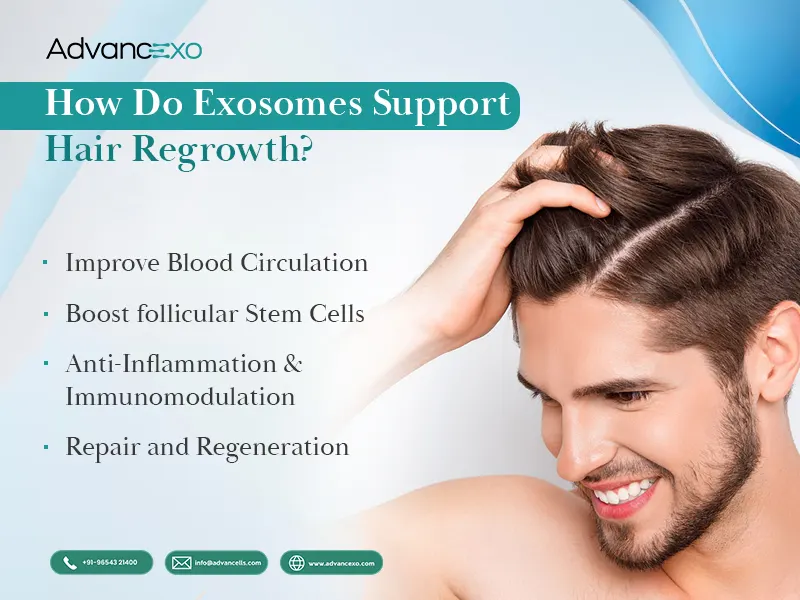
- Improve Blood Circulation: Exosomes release various growth factors (VEGF, FGF). They promote the formation of tiny blood vessels (angiogenesis) that aid in the adequate supply of blood, oxygen and nutrients to the scalp
- Boost Follicular Stem Cells: Exosomes activate follicular stem cells and stimulate new hair growth. The release of growth factors, peptides, and proteins helps activate hair follicles and stimulate naive hair growth. Exosomes actively interact with the dermal papilla and potentially activate biological circuits (Wnt/β-catenin, TGF-β/Smad pathways)
- Anti-Inflammation and Immunomodulation: Exosomes release anti-inflammatory cytokines (IL-10) that combat pro-inflammatory signals. Low-grade chronic inflammation around the hair follicle is among the major causes of hair loss. Exosomes modulate immune responses and create a calmer scalp microenvironment. They combat autoimmune reactions
- Repair and Regeneration: Exosomes send out signalling molecules that boost natural repair mechanisms. They reactivate dormant hair follicles and boost hair regrowth. Exosomes stimulate biological mechanisms by stimulating proliferation and survival pathways
Exosome Hair Treatment: What Does the Approach Involve?
Aesthetic clinics follow specialised protocols based on an individual’s needs. Dermatologists conduct detailed hair and health assessments to determine exosome hair treatment suitability.
The Key Procedure Includes:
Pre-Treatment
- Involves consultation for a holistic understanding of the individual’s specialized needs
- Determination of the underlying cause of hair loss
- Dermatologist develops a comprehensive Hair Regrowth Treatment plan
- Dermatologist possibly introduces exosomes for hair loss or combines with other treatment plans (platelet-rich plasma or microneedling)
Treatment
- Dermatologist administers exosomes for hair loss based on the treatment plan
- Various options include topical application alone or in combination with other treatments
- For better efficacy, dermatologists often combine microneedling with topical treatment application
Post-Treatment
- Dermatologists give clear instructions related to aftercare
- This is crucial for gaining long-lasting effective outcome
- Based on an individual’s needs, an individual might be recommended multiple sessions at a certain time interval
- Generally, exosomes and microneedling aftercare involves protection from direct sun exposure (UV exposure), avoiding strenuous physical activities (gym, sauna, swimming, etc.)
Why Do Dermatologists Prefer Combining Microneedling with Exosomes?
- Dermatologists often recommend exosome hair treatment followed by microneedling
- Microneedling creates tiny channels at the target site
- They boost absorption and deeper penetration of the exosomes for hair loss
- Micro-injuries trigger the body’s natural healing mechanism, increase blood circulation, and reactivate follicles by boosting collagen production
- The procedure is natural and minimally invasive. It maintains the utmost safety of the procedure
Why is Aftercare Important?
Microneedling Aftercare and Topical Exosome Application is Crucial for Gaining Effective Long-Term Outcome. This Involves:
- Maintain scalp hygiene; avoid unnecessary touching
- Avoid harsh chemical products that potentially cause irritation
- Temporary redness, irritation or tightness is normal post-procedure. This goes away within 24-72 hours
- Follow scalp routine care as instructed by dermatologist
- Effective microneedling aftercare with exosomes for hair loss imparts hair regrowth, improved hair texture, stronger hair, and improved scalp health
*NOTE: Exosome application speeds up the post-procedure recovery. However, the outcome might vary among individuals. The changes occur gradually and not overnight. It is crucial to choose clinical-grade, well-characterized exosomes for effective outcomes. Advancexo, India, is a leading manufacturer and supplier of exosomes for hair and skin rejuvenation. The product comes with a Certificate of Authentication (CoA).
Who May Consider the Approach?
- Individuals experiencing early-to-moderate stage of hair thinning/hair loss
- Individuals experiencing hair loss due to patterned baldness, autoimmune condition, or excessive hormonal fluctuation
- Individuals interested in opting for natural hair growth and a minimally invasive solution
- One opting for Exosomes Hair Treatment must enquire about the source, exosome quality, consistency and evidence-based practice
*NOTE: Opting for exosomes for hair loss must be recommended by a dermatologist and performed under expert supervision
Conclusion
Exosomes for hair loss have widely caught the interest of dermatologists and researchers. This cell-free regenerative approach efficiently stimulates hair regrowth at the cellular level. Future research must focus on exosome preparation, standardization, and treatment application. In future, the focus is on launching well-structured large-scale clinical trials for establishing long-term efficacy and safety.
FAQ’s
Q- What is an exosome hair treatment?
Exosome hair treatment introduces exosome-based formulations designed to support the scalp environment and signalling around hair follicles.
Q- Can exosomes help with hair regrowth?
Early research suggests exosomes may support processes involved in follicular activity and hair growth, but results can vary, and research is still developing.
Q- How long does it take to see results?
Hair growth takes time. Visible changes generally require patience and follow-up, with results varying based on the cause and extent of hair loss.
Q- What is important after microneedling?
Microneedling Aftercare involves maintaining scalp cleanliness and hygiene. One must avoid any harsh chemical products that cause irritation. Follow aftercare instructions and use products recommended by dermatologists.


