Rise of Exosomes in Advanced Skincare
Skin rejuvenation has entered a new era with exosomes, a science-backed technology transforming aesthetic industry.
Regenerative aesthetics with exosomes has evolved from masking ageing signs to introducing natural repairs. Exosomes, referred to as ‘ubiquitous nanoparticles’ by the International Society for Extracellular Vesicles in 2018, consist of various growth factors, miRNAs, proteins, lipids, and cytokines.
Did you know that once these exosome molecules were thought to be extracellular garbage? Currently, the position has dramatically transformed into an information highway between cells or tissues.
The exclusivity of exosomes has widely caught the attention of clinicians globally for Skin Rejuvenation or skin regeneration.
Let’s move through guided information about the role of Exosomes in Skincare.
Exosomes: Understanding the Science Behind Skin Regeneration
Exosomes are typically obtained from any type of cell population. The most potent form of exosomes is believed to be one extracted from mesenchymal stem cells. It is emerging as a cutting-edge technology for skin regeneration. The tiny vesicles consist of essential proteins, microRNAs, lipids, and growth factors. The administration of exosomes for skin boosts elastin and collagen production, resulting in skin tightening.
How do Exosomes facilitate cell-to-cell communication?
Exosomes are involved in intrinsic mechanism:
- Cellular communication,
- Delivering cargo (bioactive molecules (proteins, lipids, microRNAs)
- Modulates immune functions
- Crosses the blood-brain barrier, helps in nerve maintenance
- Releases healing signals, facilitates reprogramming of damaged cells
What Causes Skin Damage?
Several factors lead to skin damage. This includes:
- Environmental factors (UV exposure, pollution)
- Harsh skincare products (harsh chemicals, over-exfoliation, irritants)
- Lifestyle Factors (Smoke, Dehydration, Insomnia)
- Physical Injuries (Sunburns, Sun)
- Medical Issues or Trauma
How Exosomes Work in Skin Regeneration/Rejuvenation
Exosomes are Nano-messenger molecules that help with the controlled delivery of bioactive molecules to the target site. The molecules range between 30 to 200nm. These influences various cellular processes (cell signaling, immune response, gene expression and tissue repair). There are several mechanisms through which exosomes aid in skin regeneration. These include:
Mechanism of Action at the Cellular Level
- Facilitates cell-to-cell signaling messengers carrying proteins, microRNAs, lipids, and growth factors
- Penetrates skin layers to communicate with target cells directly
- Modulate the inflammatory response and boost the cellular repair mechanism.
- Improves cellular mechanisms and stimulates tissue regeneration
- Supports faster wound healing and restores skin integrity
Activation of Fibroblasts and Extracellular Matrix Remodeling
Stimulates the proliferation and migration of fibroblasts
- Boost production of extracellular matrix (ECM) components.
- Regulates matrix metalloproteinases (MMPs), facilitates balance between tissue breaks and repair.
- Promotes smoother skin texture
Impact on collagen and elastin production
- Promotes the synthesis of elastin and collagen fibers
- Improves skin resilience towards a harsh environment
- Prevent collagen degradation
- Strengthen dermal architecture
- Results in tighter, smoother and firm skin
Skin Regeneration: Clinical Benefits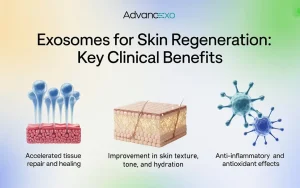
- Accelerated tissue repair and healing
- Improvement in skin texture, tone, and hydration
- Anti-inflammatory and antioxidant effects
Exosomes in Skincare
Exosomes from Mesenchymal Stem Cells (MSCs) play a pivotal role in treating several skin-associated clinical conditions. These include:
Hyperpigmentation and Melanogenesis
- Exosomes counteract melanin production (melanogenesis- determines skin colour)
- microRNAs carried by exosomes inhibit tyrosinase and melanogenesis (the process responsible for excess melanin production)
- Exosomal microRNAs (miR-2478) suppress Rap1a (regulatory role in melanin production)
Aging
- Exosomes modulate keratinocytes and fibroblasts production.
- Reduces wrinkles, hydrates skin and enhances skin barriers
- Protects skin from UV photoageing
- Inhibits the expression of UVB-induced MMP-1 and MMP-3 expression
- Boost collage synthesis
- Regulates the action of UV-induced ROS generation
Inflammation
- Inflammation includes acute or chronic types.
- Clinical conditions include psoriasis, rosacea, and eczema.
- Exosomes regulate immune response and inflammatory pathways.
- Reduces facial erythema (redness of skin/ dilated capillaries)
- Suppresses pro-inflammatory cytokines
- Promotes anti-inflammatory cytokines
Wound Healing
- Regulates angiogenesis, cell proliferation and migration
- ECM remodelling
- Promotes tissue regeneration
- In diabetic ulcers, exosomes aid in faster wound closure.
- Promotes wound healing by regulating lncRNA H19 and SOX9
Exosome Skin is: Route of Administration
Topical Application
- Formulated in the form of serums, lotions or creams
- Non-invasive administration, minimal risk or downtime
- Passive diffusion (stratum corneum)
- Reaches the dermal layer for microcirculation
Transdermal Application
- Transdermal application of exosomes skincare is widely used. Advantages includes ease of administration and reduction in systemic side effects.
- Penetrates the skin barrier through the stratum corneum
- Movement with a concentration gradient
- Post-adsorption exosomes reach dermal capillaries and enter systemic circulation
Microneedling
- Dermatologist performs micropunctures on the skin surface, followed by exosome application.
- Allows deeper penetration of exosomes
*NOTE: Based on the skin condition or problem, the dermatologist determines the suitable administration route
Exosomes in Skincare: Recent Innovations and Advancements
Exosome skincare grabbed huge attention in regenerative aesthetics. Some latest developments include:
- Use of high-purity isolation techniques (size-exclusion chromatography, tangential flow filtration) ensures consistent exosome formulation.
- Lyophilized (freeze-dried) exosomes, improved stability, safety, and shelf life
- Developing innovative topical and transdermal application formulation
- Elevated clinical application- anti-aging, hyperpigmentation, melasma, etc.
Treatment Process: How Exosomes Are Used in Skincare
General steps involved in the Exosomes Skin Care process:
- Skin Assessment: evaluating skin type, problem, and treatment goals
- Administration Route: selection of appropriate exosome formulation and delivery method
- Skin Preparation: gentle cleansing of the skin
- Application: exosomes administration (e.g., topical, transdermal, microneedling, laser-assisted infusion)
- Post-treatment care: sun protection, application of calming product
- Healing & Regeneration: reduced inflammation, improved skin repair, progressive collagen and elastin production
- Aftercare or Follow-ups: assessing treatment response
Who is are Ideal Candidate for Exosomes in Skincare
- Individuals of all ages and genders
- Early to moderate signs of aging (wrinkles, fine lines or loss of firmness)
- Patients seeking advanced skin tightening solutions
- An individual with uneven skin tone
- Individuals with hyper-sensitive and inflamed skin
- Skin with acne, scars, textural irregularities or enlarged pores
- Individuals seeking regenerative, science-backed solutions
Safety, Efficacy, and Clinical Evidence
Exosome therapy is primarily safe and is associated with some short-term side effects. These include:
- Mild Redness
- Warmth or Heat sensation
- Swelling
- Itching
- Tenderness
*NOTE: Exosomes in skincare must be of superior quality. Advancexo, India, is one of the leading laboratories that follows GMP-certified, stringent safety protocols for exosome extraction, maintenance and research.
Post-Treatment Care
Dermatologists recommend aftercare for optimal results. Some critical aspects after the regime include:
- Avoid direct sun or heat exposure
- Use of protective ointment, creams and protective clothes
- Use soothing products (e.g, ceramides, hyaluronic acids)
- Avoid harsh product (Vitamin C, retinols)
- Avoid using harsh chemicals or makeup for up to 24-72 hours after the application
- Avoid excessive skin exfoliation
What to Expect?
- Improved Skin Quality
- Deeper skin regeneration
- Radiant, glowy, and plumper skin
- Long-term visible effect
*NOTE: The number of sessions recommended depends on the identified problem.
‘Myths’ or ‘Facts’
Myth: Exosomes and Stem cell Therapy are the same
FACT: Exosomes are non-living tiny extracellular vesicles that stimulate skin cells’ repair and lead to skin rejuvenation
Myths: Immediate results
FACT: Exosomes stimulate the body’s natural regenerative process. The visible improvement in skin tone, texture, collagen and elastin production generally occurs over several weeks to months.
Myth: All exosomes are equally effective
FACT: Efficacy of the product depends on its isolation process, safety protocols, and source of isolation
Myth: Exosome induces a severe immune reaction
FACT: Highly purified, superior-quality exosomes are safe and have minimal risk of immune rejection
FAQ’s
Q- How do exosomes in skin care work?
Exosomes are nano-vesicles that release crucial proteins, growth factors, and signalling molecules, aiding in skin regeneration or rejuvenation from within.
Q- What are exosomes in skincare?
Exosomes in skincare are tiny vesicles that support skin regeneration or rejuvenation. This is modulated by improved elastin or collagen production, activating the repair mechanism, boosting fibroblast production and migration.
Q- What are common skin conditions treated with exosomes?
The common skin conditions include signs of ageing (wrinkles or fine lines), scars, or acne. Exosomes for Skin Tightening have favorable outcomes with no serious side effects. Exosomes can treat chronic conditions like diabetic ulcers or wound healing.
Q- Are exosomes in skincare safe?
Exosomes processed under highly regulated conditions and applied under professional guidance are considered safe.