What if the future of skin rejuvenation goes beyond what traditional skincare can offer?
From uneven pigmentation and dullness to fine lines or changes in skin texture, the aesthetic industry is exploring new ways to improve overall skin quality. One emerging area gaining attention is Exosomes Skin Care. This advanced regenerative approach focuses on the role of cellular communication in skin health and rejuvenation.
Exosomes carry biological signals between cells, making them an area of interest in research on skin repair, collagen-related activity and visible signs of aging. Their growing use in aesthetic discussions has also raised interest in combining exosome-based products with procedures such as microneedling.
But can exosomes deliver the skin benefits people expect? While early findings are promising, results depend on the product, its quality and its administration procedure. Understanding the science, potential applications and safety considerations can help both dermatologists and potential candidates make informed decisions. The current article unveils the science behind exosome skin care and proposes its potential to reshape skin rejuvenation.
Understanding Exosomes and Skin Health
Exosomes are nano-sized (30-150 nm) sac-like structures that are released by various cells. They act as bioactive molecule carriers that stimulate cellular signals. Various bioactive molecules include proteins, microRNAs, cytokines, growth factors, lipids and signalling molecules. With aging or exposure to external stressors, the ability of skin to self-renew decreases. The ability of the skin cells to send out adequate signals gets compromised. Skin gradually displays changes including fine lines, wrinkles, freckles, patchy appearance, dullness, and uneven skin tone. Exosome treatment for skin is an advanced regenerative solution that efficiently supports skin recovery.
What are the Key Skin Problems/Changes?
- Ageing: With ageing, various changes in the skin appear from within. Fine lines, wrinkles, freckles, loss of elasticity or firmness, uneven skin texture, damaged skin barriers, enlarged skin pores, dehydration and dullness appear
- Hyperpigmentation: Uneven skin tone, patchy or pigmented skin, post-inflammatory hyperpigmentation (PIH), etc. Appears at distinct spots on the face
- Melasma: Grey, brown or bluish patches on distinct body parts. Most common areas include nose, chin, forehead, cheeks, and upper lip. Often occurs due to hormonal fluctuation or exposure to environmental stress. The major challenge is its frequent recurrence
- Skin Texture Change & Post-Acne Concern: irregular skin texture, enlarged skin pores, acne-associated marks or scars
- Dehydration & Environmental Stressor: Dry and dull skin, reduced radiance, and other visible changes due to prolonged sun exposure or pollution
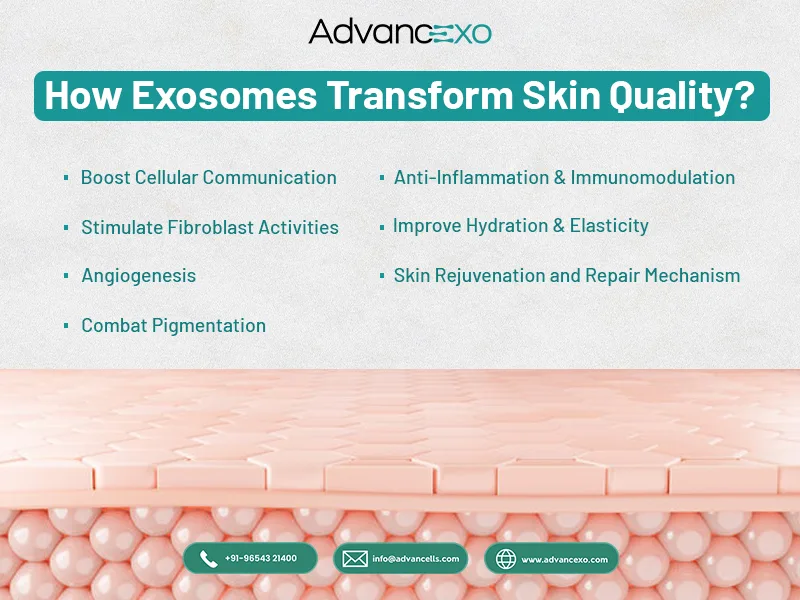
How Exosomes Transform Skin Quality?
Exosomes Skin Care Targets the Root Cause of the Distinct Skin Problem. The Key Mechanism Includes:
- Boost Cellular Communication: Exosomes release various cytokines and growth factors that stimulate cell-to-cell communication
- Stimulate Fibroblast Activities: Exosomes stimulate fibroblast activities. They boost collagen and elastin production (structural proteins responsible for maintaining skin elasticity)
- Anti-Inflammation & Immunomodulation: Exosomes release various anti-inflammatory molecules. They combat the action of pro-inflammatory cytokines that reduce low-grade chronic inflammation. They calm the surrounding environment and modulate the immune response
- Improve Hydration & Elasticity: Exosomes repair skin barriers. They improve skin’s ability to retain moisture and make skin look plumper. Improves skin firmness and elasticity
- Angiogenesis: Exosomes release various growth factors (VEGFR, FGFs, etc.) that enable tiny blood vessel formation
- Skin Rejuvenation and Repair Mechanism: Exosomes stimulate various cellular signals that stimulate naive cell proliferation. They stimulate the repair mechanism and boost cellular turnover
- Combat Pigmentation: Exosomes introduced for Skin Pigmentation Treatment stimulate melanocyte activity (specialized cells that are responsible for melanin production). They actively address the condition of hyperpigmentation or stubborn conditions with melasma
Exosomes After Microneedling: A New Skincare Approach
Dermatologists often combine other established approaches like microneedling with exosomes. This is a non-invasive cosmetic approach with minimal downtime. Dermatologists use tiny needles to create controlled punctures in the targeted skin. This naturally stimulates collagen and elastin production. Microneedling followed by topical exosomes skin care application enables deeper penetration. The combination of microneedling and exosomes skin care application boosts skin elasticity, reduces pigmentation, improves signs of ageing, and imparts rejuvenated skin. Candidates opting for exosomes after a microneedling approach must follow aftercare instructions for enhanced outcomes.
The Primary Aftercare Includes:
- Use regular of sun protection (>50 SPF++) and protective clothing
- Follow a gentle skincare routine; use products recommended by a dermatologist
- Avoid strenuous exercise, sauna, and excessive heat exposure atleast 48-72 h after the procedure
- Individuals often seek exosomes for skin before and after post-treatment. To gain the best outcome, one must ensure choosing superior quality exosomes and follow skin care after microneedling
Safety, Quality and Choosing the Right Exosomes
Exosomes Treatment for Skin requires choosing superior quality exosomes. The key considerations include:
- Procure clinical-grade, superior-quality exosomes
- Consider the source, isolation procedure, characterization, and storage conditions
- Consult an experienced dermatologist and a renowned clinic before opting for any skin care treatment
- Consider an effective administration method based on the individual’s personalised needs
- Currently, exosomes for skin rejuvenation are evolving and are at an early stage of clinical application. Future research focuses on developing well-structured, large-scale clinical trials to generate long-term data
*NOTE: Don’t rely on every marketing campaign claiming exosomes as a super skincare product. It is crucial to have a detailed discussion with a dermatologist related to the treatment procedure and product. Advancexo, India, is a leading manufacturer and supplier of exosomes for advanced skin and hair rejuvenation. Each batch of the products is well-characterised to ensure its quality. The product comes with a Certificate of Authentication (CoA).
The Future of Exosomes in Aesthetic Dermatology
- Exosome skin care is an evolving approach that targets skin issues at the cellular level. They support multiple skin problems simultaneously
- To combat pigmentation issues, exosomes modulate melanocyte activities from within. They potentially combat recurrence
- Dermatologists are combining microneedling with exosome application. They enable deeper penetration of the exosomes
- It is crucial to choose a clinical-grade product. The exosomes must be well-characterised, have a consistent formulation and use reliable quality control procedures
- Future research focuses on developing large-scale clinical trial data to establish long-term safety and efficacy
References
- Sreeraj H, AnuKiruthika R, Tamilselvi KS, Subha D. Exosomes for skin treatment: therapeutic and cosmetic applications. Nano TransMed. 2024 Dec 1;3:100048.
- Villarreal-Gómez LJ, Origel-Lucio S, Hernández-Hernández DA, Pérez-González GL. Use of exosomes for cosmetics applications. Cosmetics. 2025 Jan 13;12(1):9.
FAQ’s
Q- Can exosomes help with pigmentation and uneven skin tone?
Exosomes are gaining attention in aesthetic skincare for their potential role in improving skin quality and uneven tone. However, their effectiveness for pigmentation is still being studied. The results potentially vary depending on the cause of pigmentation, the product used and the overall skincare approach.
Q- Can anyone use exosome-based skincare products?
Not every product is suitable for every skin type. If the skin is sensitive, acne-prone or prone to pigmentation, it is best to consult a dermatologist before trying exosome-based skincare. The product formulation and how it is used also matter.
Q- Are exosomes useful for skin care after microneedling?
Some aesthetic practitioners include topical exosome-based products in post-microneedling protocols. However, not all products are suitable for use on freshly treated skin. A dermatologist should assess the product’s quality, safety and intended use before recommending it.
Q- How long does it take to see results from exosome treatment for skin?
There is no fixed timeline for visible results. It depends on the skin concern, the product and the treatment protocol. Changes in skin texture or overall appearance may take time, and the evidence supporting consistent results is still developing. Following a suitable skincare routine and dermatologist’s advice is crucial in informed decision making.