

Finding a Solution to Androgenetic Alopecia?
Overwhelmed due to hair loss- what if we tell you that microscopic messengers in the form of ‘Exosome Treatment for Hair Growth’ can awaken weakened hair follicles?
Hereditary hair loss or ‘Androgenetic alopecia’ affects a large number of the population globally. It is the most common cause of hair loss affecting both men and women at all ages. Early diagnosis and broad-spectrum treatment remain an important step in preventing hair loss. Yet, the conventional treatment requires lifelong use or has a limited short-term effect.
Consequently, the treatment consideration for androgenetic alopecia becomes confusing due to mountains of information spread over the internet. The information and disinformation create immense challenges for those seeking effective solutions. Exosome Treatment for Hair Growth has emerged as a regenerative solution in recent times. We recommend making informed choices based on your specific problem.
What Causes Androgenetic Alopecia?
Androgenic alopecia is a genetic/hereditary condition that is inherited from parents. Research reflects hereditary hair thinning to cause hair loss in patches, or ‘patterned baldness’. The individual’s hair color, texture, scalp, type and hair length affect the appearance of scalp coverage. For men the baldness appears in the following areas: the top of the scalp, or crown. Among women, the thinning appears systematically on top of the scalp and becomes more widespread. The causes include:
- Hormonal imbalance, excessive conversion of testosterone into dihydrotestosterone (DHT) under the influence of androgens
- DHT binds with hair follicle receptors
- Hair growth phase (anagen) shortens.
- Follicular miniaturization, or follicle size decreases.
- Disruption of the hair cycle (shortening of the anagen phase; prolonged telogen phase)
- Hair becomes thinner, lighter, and shorter; gradually, hair growth halts.
What are the Current Treatments Approaches for Androgenetic Alopecia?
A dermatologist recommends treatment based on the problem severity and patient’s specific need. This includes:
- Medication: prolongs hair growth phase, lowers DHT levels via blocking the destructive effect on follicles
- Lifestyle Management: stress management, sleep pattern, intake of nutrition-rich diet (Vitamin B, D3, zinc, iron, omega-3), avoiding environmental stress like UV exposure, maintaining hair hygiene
- Local Procedure or Therapy: PRP, mesotherapy
- Hair Transplantation: In later stages of hair loss, a dermatologist recommends hair transplantation
- Exosome Therapy: Exosome therapy involves administration of exosomes (tiny nano-sized vesicles) that activates dormant hair follicles. They promote cellular communication and boost hair growth.
Although the conventional treatment is well established, they come with critical limitations:
- Prolonged use of medication has severe side effects
- Medication, lifestyle changes, and local procedures are effective during early diagnosis
- Hair transplantation is a surgical procedure
The conventional treatment for hair loss faces major limitations and side effects; regenerative approaches are emerging as popular alternatives.
Exosome Therapy- Redefining Regenerative Hair Loss Solution
Exosomes are nano-sized vesicles (30-150 nm) that are secreted naturally by cells. Mesenchymal stem cells (MSCs) derived exosomes are widely trusted by dermatologists as advanced solutions for hair loss. The tiny messengers are bioactive cargos- carrying proteins, growth factors, microRNAs, and cytokines. These molecules stimulate the regeneration of hair follicles. Research suggests MSCs-derived exosomes have the ability to reverse hair thinning and promote hair regrowth.
How Exosome Treatment for Hair Loss Works?
Exosome treatment for hair growth works via a multifold mechanism. This includes: 
- Hair Follicle Stem Cell Stimulation: exosomes stimulate dermal papilla cells and activate follicular stem cells. The trigger proliferation of dormant hair follicles is crucial for hair cycling. Reactivation of hair follicles pushes the entry of follicles into the anagen (growth) phase.
- Promote Blood Circulation: Exosomes release growth factors (VEGFs, FGFs, PDGFs). They promote angiogenesis (new blood vessel formation). Promotes oxygen and nutrient supply in the scalp via the blood
- Anti-Inflammation: Chronic inflammation contributes to hair follicle damage. Exosomes excrete anti-inflammatory cytokines that reduce scalp inflammation. They modulates inflammatory responses that create a supportive scalp microenvironment.
- Extension of Anagen Phase: Modulates signaling pathways (Wnt/β-catenin), prolongs activation of the anagen phase
- Growth Factors: Exosomes release growth factors that support cell proliferation and regeneration. They trigger repair mechanisms and support the survival of surrounding hair follicles.
- Immunomodulation: MSCs-derived exosomes display immunomodulatory properties. They regulate local immune response, reduce inflammation and create a favourable environment for hair regrowth.
Is Science Backing Up the Claims?
Exosomes Therapy for Hair Loss is becoming a popular choice of dermatologist in recent times. The secret underlies scientific evidence. Preclinical and clinical research outcome shows:
- Umbilical cord-derived MSCs’ exosomes significantly promoted hair regeneration. Exosomal microRNA (miR-146a-5p, miR-21-5p and let-7b-5p) activates the Wnt/β-catenin signalling pathway. This stimulated dermal papilla cell proliferation and enhanced hair follicle regeneration [1, 4]
- Adipose-derived MSCs’ exosomes improved dermal papilla proliferation and migration. Exosomes counteracted the negative effects of DHT [2]
- Exosomes stimulated hair follicle stem cell proliferation and reduced apoptosis. The increased influence of genes such as LEF1, IGF1R, and TGF-β pathways created a supportive scalp microenvironment [3]
How is Exosome Therapy for Hair Loss Performed?
The procedure of Exosome Therapy for Hair Loss involves:
- Scalp assessment, cause and pattern of hair loss, hair type, blood report, etc.
- Isolation of MSCs-derived exosomes and quality check
- For treatment, the scalp is cleaned thoroughly
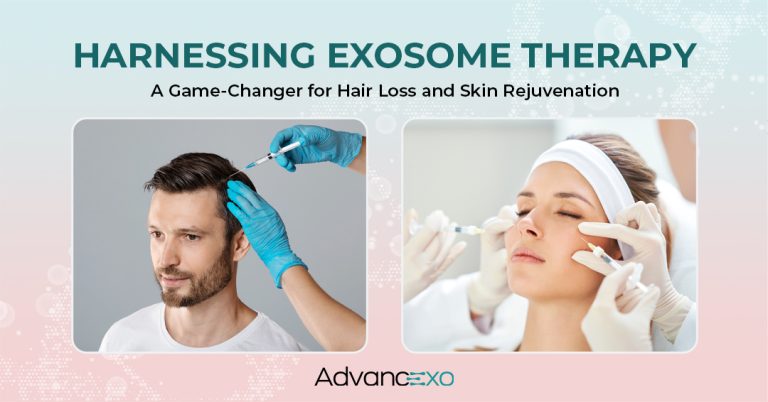
- Microneedling in the areas of application to create minute punctures (1.5-2 mm)
- Topical application of exosomes (exosomes massaged in the selected area)
- Microneedling, followed by exosome application, aids in the deeper penetration of exosome
- There is minimal downtime after the procedure. The individual can resume day-to-day activity immediately after the procedure.
*Exosome Treatment for Hair Growth should be of superior quality. Isolated exosomes must have intact protein, growth factors, microRNAs, and cytokine content. Advancexo, India, manufactures GMP-certified protocols and supplies clinical grade products.
Benefits of Exosome Therapy for Hair Thinning
- Non-surgical, minimally invasive procedure
- The regenerative approach enables natural hair regrowth
- Reduces scalp inflammation and promotes activation of dormant hair follicles
- Activates follicle stem cells
- Improves hair density, thickness, and scalp microenvironment
- Minimal downtime in comparison with hair transplantation
Who Is the Ideal Candidate for Exosome Therapy?
- Individuals with hereditary hair loss
- Individuals at the early-to medium stage of androgenetic alopecia
- Patients seeking natural and non-surgical hair restoration
Are There Any Risks or Safety Concerns?
Preclinical and clinical implications of Exosomes for Hair Loss Treatment are reported as safe. The short-term side effect includes:
- Redness or tenderness at area of application
- Mild selling or bruising as part of the normal body’s inflammatory response
- Initial temporary shedding of hair during the transition phase
*Currently, a large-scale clinical trial for establishing the long-term safety of the procedure is desirable
Conclusion
Yes, the exosome treatment for hair growth is fairly worth the hype. It enables hair regrowth naturally with negligible side effects. The science-backed procedural safety has secured its crucial position in the aesthetic industry. Dermatologists are backing the procedure as the next-generation revolution in hair regrowth treatment.
References
- Wang Z, Chai Z, Xu X, Piao Y, Gong L. Lithium chloride-treated human umbilical cord mesenchymal stem cells-derived exosomes promote hair growth by regulating miR-146a-5p-wnt pathway. Stem Cells Translational Medicine. 2025 Oct;14(10):szaf049.
- Li J, Zhao B, Yao S, Dai Y, Zhang X, Yang N, Bao Z, Cai J, Chen Y, Wu X. Dermal PapillaCell-derived exosomes regulate hair follicle stem cell proliferation via LEF1. International journal of molecular sciences. 2023 Feb 16;24(4):3961.
- Yu A, Zhang Y, Zhong S, Yang Z, Xie M. Human umbilical cord mesenchymal stem cell-derived exosomes enhance follicular regeneration in androgenetic alopecia via activation of Wnt/β-catenin pathway. Stem Cell Research & Therapy. 2025 Aug 1;16(1):418.
- Fu Y, Han YT, Xie JL, Liu RQ, Zhao B, Zhang XL, Zhang J, Zhang J. Mesenchymal stem cell exosomes enhance the development of hair follicle to ameliorate androgenetic alopecia. World Journal of Stem Cells. 2025 Mar 26;17(3):102088.
FAQ’s
Q- Can Exosome Therapy Treat Hereditary Hair Loss?
Exosome therapy helps with hereditary hair loss by stimulating dormant hair follicles. They deliver bioactive molecules- proteins, microRNAs, growth factors, and cytokines that naturally promote hair growth.
Q- How Long Does the Result Appear After Exosome Treatment for Hair Growth?
Among most of the individuals, a significant reduction in hair shedding is observed. The improved hair density and texture appear within 3-4 months.
Q- Who Should Consider Exosome Therapy for Hair Thinning?
The candidates who are at early to moderate stages of hair thinning can undertake exosome treatment. Preclinical and clinical studies have shown positive outcomes with exosomes in hair regrowth.
Thanks for breaking down the science behind exosome therapy for hair growth—it’s refreshing to see a clear explanation of how these tiny messengers can potentially revive dormant follicles. As someone dealing with early-stage hair thinning, I appreciate the emphasis on personalized treatment and the importance of moving beyond just symptom management. It’s also reassuring to know that this approach is gaining traction in regenerative medicine, though it’s still important to stay informed about ongoing research and individual results.
Thank you for reaching out. We understand that you are at an early stage of hair loss—this is actually the phase where exosome therapy tends to be most effective. Of course, your medical history and condition need to be properly evaluated before suggesting the best approach. Please feel free to connect with us for further guidance, and thank you for your continued support and trust. Please contact us via WhatsApp or call us at +91-9654321400, or mail us on info@advancells.com for more information. We’re here to support you every step of the way.