Beyond Hair Loss: Why Regeneration Is Rewriting the Narrative
Hair regrowth is no longer about chasing the quick fixes- exosomes for hair loss target what’s happening deep within the follicle.
For decades, hair loss treatments have focused on combating the visible symptoms like hair thinning or excessive shedding. In fact, the solution remained constraints from oral supplementation/medication to hair masking.
Consequently, the emergence of regenerative technology has definitely taken a leap. The focus has shifted from chasing surface-level fixes to science-backed solutions. Today, Exosomes for Hair Loss have gained global attention among dermatologists as a biology-driven, natural way to support hair regrowth.
The Biology of Thinning: A Follicle Under Stress
Hair thinning does not occur overnight- the shift occurs slowly beneath the surface. Your scalp has its own ecosystem, and a balanced and healthy environment supports sustainable hair growth. However, conditions like stress, hormonal imbalance, lifestyle factors, or autoimmune conditions can introduce alterations.
Over time, the signals promoting hair growth weaken or become inconsistent. Inflammation quietly takes a toll from within. Your follicle begins to shrink (follicle miniaturization), making new hair finer and weaker between hair cycles.
The tricky part is that most of the conventional treatments do not actually address anything at a deeper level. They strive to manage symptoms, but miss out on reversing the underlying changes. Exosome Therapy for Hair Loss steps in at this point, i.e. they target the follicle microenvironment, correct disrupted signals, combat inflammation and boost healthier hair regrowth.
Exosomes, Decoded — Not Just Another Buzzword
Exosomes are nano-sized (30-150 nm) bioactive molecules that are becoming an integral part of aesthetic medicine. These tiny messengers, once thought to be ‘garbage’ or ‘cellular trash’, are actually regenerative bombs. Inside the body, exosomes act as a ‘postman’ that facilitates cellular communication.
Exosomes are cargoes that carry distinct biological molecules, including proteins, microRNAs, cytokines, and growth factors. Exosome Therapy for Hair Loss involves delivering exosomes to the target area of the scalp. They stimulate hair follicle activities naturally, boost blood circulation in the scalp, and minimize inflammation.
What Follows Next?
Exosomes for hair loss intertwine several molecular mechanisms and bring long-term noticeable changes. This includes:
- Reignite Hair Growth: Exosomes carry various growth factors that trigger hair regeneration. They activate the dormant hair follicles and push hair into anagen (growth) phase. Exosomes activate follicle stem cells and trigger new hair growth.
- Anti-Inflammation: Scalp inflammation is among the major factors for hair loss. Exosomes secrete several anti-inflammatory molecules (TGF-β, IL-10, IL-4, etc.). These molecules inhibit pro-inflammatory signalling networks and reduce scalp inflammation.
- Immunomodulation: Exosomes carry various microRNAs (miR-21, miR-146a, miR-690, etc.) and cytokines that modulate the immune system. This creates a healthier scalp microenvironment.
- Improve Hair Density: Exosomes release various growth factors that nourish damaged hair follicles. It improves hair density, texture, lustre, and overall quality. This helps you flaunt your fuller hair look.
- Natural Solution: Exosomes are naturally excreted by various human cells. For hair loss treatment, mesenchymal stem cells (MSCs)-derived exosomes are widely used. Exosomes are applied on target area, rewiring cellular mechanisms from within, and bring changes naturally [1]
Your Step-Wise Guide: Exosome Treatment for Hair Loss
Exosomes for hair loss involve a multistep process. This involves:
- Patient’s Consultation: Through assessment of the patient’s condition to assess the cause and extent of hair loss. Overall health assessment to determine the suitability of exosome application
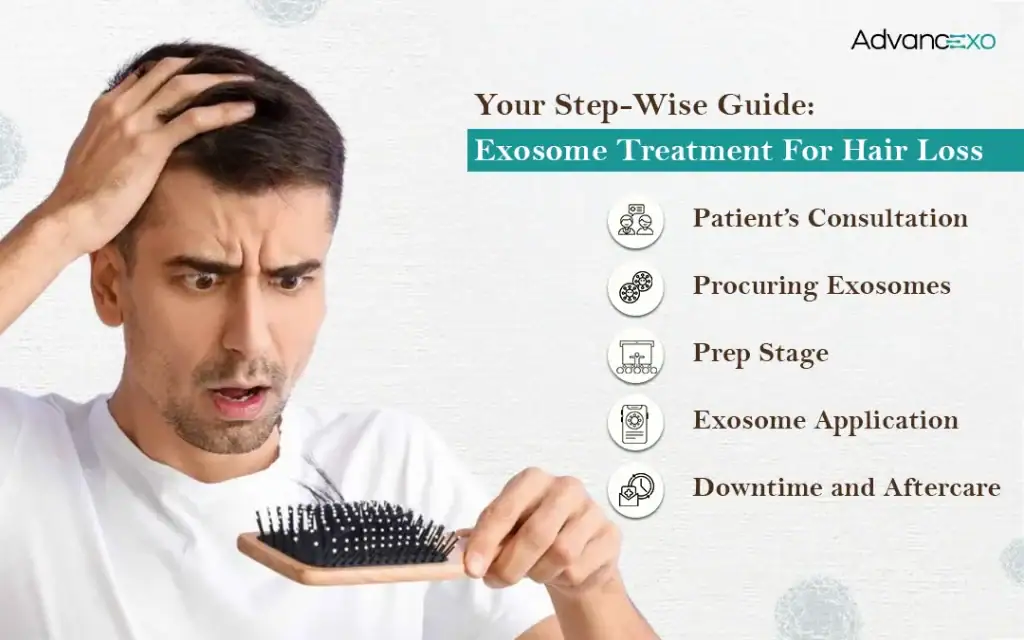
- Procuring Exosomes: Exosomes are harvested from suitable cell sources. The exosomes used must be of superior quality (intact concentration of proteins, growth factors, cytokines, and microRNAs)
- Prep Stage: Cleansing of the individual’s scalp, localized application of numbing cream
- Exosome Application: Dermatologists determine the appropriate administration mode. Topical application involves massaging exosomes on target areas. Microneedling followed by topical application. It involves creating tiny punctures (0.5-1.5 mm) on the application site. Exosomes in subsequent quantities are topically massaged at the target site. The latter application mode allows deeper penetration of exosomes.
- Downtime and Aftercare: There is minimal downtime with exosome application. The individual can resume their daily life activities immediately. Aftercare is a crucial element in producing long-term outcomes. Attend follow-up sessions recommended by your dermatologist.
Outcomes Without Hype: What Changes Occur Over Time?
Exosome Therapy for Hair Loss introduces changes gradually. The typical timeline for changes includes:
- 0-30 Days: Initial phase, exosome reduces scalp inflammation and stimulates follicle activities. The change occurs from within, while the visible changes are minimal
- 30-60 Days: Initial improvement in scalp health and hair texture. Some individuals experience a noticeable decreased hair shedding
- 60-90 Days: Active growth Phase, Noticeable hair regrowth occurs, new hair growth on hair thinning area
- 90 Days – 9 Months: Peak result, individual experience healthier hair, improved density, better coverage. More hair has gained a prolonged anagen phase
- 9-12 Months: Maintenance phase, the visible result lasts for a longer time with adequate aftercare. Follow-up treatments are recommended. A dermatologist might recommend more sessions (depending on the individual’s response)
*NOTE: Hair regrowth occurs gradually, expect a realistic result
Before & After: Interpreting Results with a Clinical Lens
Exosomes for Hair Loss Before and After are often misinterpreted. Judge the result by considering clinical lenses. Before opting for exosome therapy, you must understand:
Visual Comparisons are Misleading.
- Style, angle and light impact the visible results in the photo
- Subtle improvement in thickness does not always translate on camera
- Early-stage changes aren’t visible in pictures
- Individuals experiencing permanent scarring/ cicatricial alopecia (destruction of hair follicles) cannot benefit from exosome therapy.
Outcomes Derived From the Angle
- The quality of the exosome and the source play a vital role
- Stage and severity of hair loss
- An individual’s health condition and response to therapy
- Age, hormonal status, metabolic condition, environmental factor exposure, etc
- Lifestyle choices like nutrition, stress, aftercare, etc.
We Encourage Setting Grounded Expectations.
- Exosomes for hair loss introduce changes gradually.
- The goal is to boost hair regrowth, hair density, texture, and overall quality. Don’t expect an overnight transformation.
- An individual’s follicle variability impacts the outcome
- Exosome therapy boosts hair regrowth- it cannot guarantee complete restoration
*Advancexo, India, is a leading supplier of superior quality MSCs-derived exosomes for aesthetic applications (hair and skin).
Who Truly Benefits?
- Early to moderate stage of hair loss
- Experiencing diffuse thinning
- Chronic scalp inflammation or allergic reaction
- Non-respondent to other conventional therapy
- Supportive therapy in combination with other conventional options or hair transplantation
- Patients with alopecia areata (autoimmune condition) or Androgenic alopecia (pattern baldness)
- An individual looking for a natural hair regrowth option
Who Doesn’t Get Benefited?
- An individual with permanent scarring (complete hair follicle destructed)
- Uncontrolled scalp condition (infection, dermatitis, psoriasis)
- Skin cancer or melanoma
- An individual expecting an overnight outcome
Final Perspective: The Truth About Hair Regrowth
- Exosomes for hair loss support hair regrowth — don’t expect a miraculous experience
- Suitable for individuals experiencing chronic scalp inflammation or allergies
- Large-scale clinical data are desirable for establishing long-term efficacy and safety
- Make a sound decision based on clarity and scientific evidence, and not on hype
- Consult an experienced dermatologist, gain suitable guidance and say goodbye to hair loss woes
References
- Kost Y, Muskat A, Mhaimeed N, Nazarian RS, Kobets K. Exosome therapy in hair regeneration: a literature review of the evidence, challenges, and future opportunities. Journal of Cosmetic Dermatology. 2022 Aug;21(8):3226-31.
FAQ’s
Q- What are Exosomes for Hair Loss Treatment?
Exosomes are nano-sized extracellular vesicles that act as bioactive molecule cargo. They carry essential proteins, cytokines, growth factors, and microRNAs that trigger dormant hair follicles. This promotes hair regrowth, combats scalp inflammation and creates a supportive scalp microenvironment.
Q- How Many Sessions are Required for Exosome Therapy?
The number of sessions depends on the individual’s response and hair fall severity. Typically, 3-4 sessions produce long-term noticeable outcomes.
Q- What Hair Loss Problem Does Exosome Therapy Treat?
Androgenic alopecia (pattern baldness) and alopecia areata (an autoimmune condition) are the most common causes of hair loss. Exosome therapy has shown significant positive outcomes in treating both of these conditions.