
A smooth, refined skin complexion isn’t just about how the skin appears; rather, it is more about how the skin feels or behaves.
Skin texture represents the appearance of the skin surface. Gradually uneven skin texture appears with prolonged direct sun exposure, acne, environmental factors or dehydration. Currently, the aesthetic skincare regimen intends to move beyond the surface-level correction. It focuses on supporting overall skin quality. Along with the established conventional approaches, advanced regenerative solutions are evolving rapidly. Infact, exosomes have gained immense popularity for their role in boosting cellular communication and their potential to induce the body’s natural repair mechanism. Dermatologists and researchers are continuously exploring the ways exosomes can fit into modern-day aesthetic care to improve skin texture.
The current article explores the available options and emerging solutions to improve Skin Texture. It explores the potential of regenerative approaches as a long-term solution to gain smoother skin texture as evidence-based aesthetic care.
How Does Uneven Skin Texture Appear?
Uneven Skin Texture Might Have Distinct Appearances, Including:
- Rough/Flaky Skin: Dry, uneven skin texture might appear as a scaled surface. This generally appears due to dead skin accumulation or an insufficient skin barrier
- Bumpy Texture: Certain small raised skin surface leading to congestion or blocked skin pores.
- Pitted Texture: Indentation of the skin surface that generally appears due to atrophic acne scarring. Such a condition appears due to boxcar, rolling or ice pick scars.
- Enlarged Pore Texture: Enlarged skin pores appear due to compromised skin barriers. The skin surface appears coarser, often associated with high sebum production, skin fitness loss or congestion.
- Crepey Texture: Crinkled fine texture generally appears on eyelids, body or neck region
- Dull/Flat Texture: Accumulation of dead skin cells, dehydration or lack of skin renewal makes skin appear dull. The light-reflective quality of the skin declines
Why Does Skin Texture Become Uneven?
Uneven Skin Texture Occurs Due to Multiple Factors Including:
- Slow Skin Turnover: Chronological aging leads to a gradual slowdown of cellular turnover, natural reduction of oil production, and breakdown of the supportive dermal fibers. With a reduction in the turnover rate, dead cell accumulation creates rough, dull and uneven skin texture.
- Reduced Collagen/Extracellular Matrix Support: Prolonged sun or UV exposure fragments collagen or elastin (the supportive ECM proteins), leading to rough patches, enlarged pores or leathery skin texture
- Congestion and Blocked Pores: Skin pores get clogged with excessive sebum production and dead cell accumulation. Congestion makes the skin surface appear uneven.
- Acne scarring: Atrophic acne scars or post-inflammatory hyperpigmentation (PIH) lead to structural changes to the skin. In severe cases, the depression or indentation appears as permanent scars.
- UV Damage: Prolonged sun exposure thickens the stratum corneum (outer skin layers), resulting in structural irregularities. This leads to disruption of collagen and elastin structure. Besides, photoaged skin consistently leads to coarser skin texture.
- Decline in Structural Support: The skin gets thinner, which makes the skin surface less even, leading to surface irregularities.
- Dehydration: Lack of adequate moisture makes skin appear less plump or smooth. This increases skin surface irregularities.
- Keratosis: Certain skin conditions such as keratosis pilaris, sebaceous hyperplasia, milia, etc. compromise skin texture
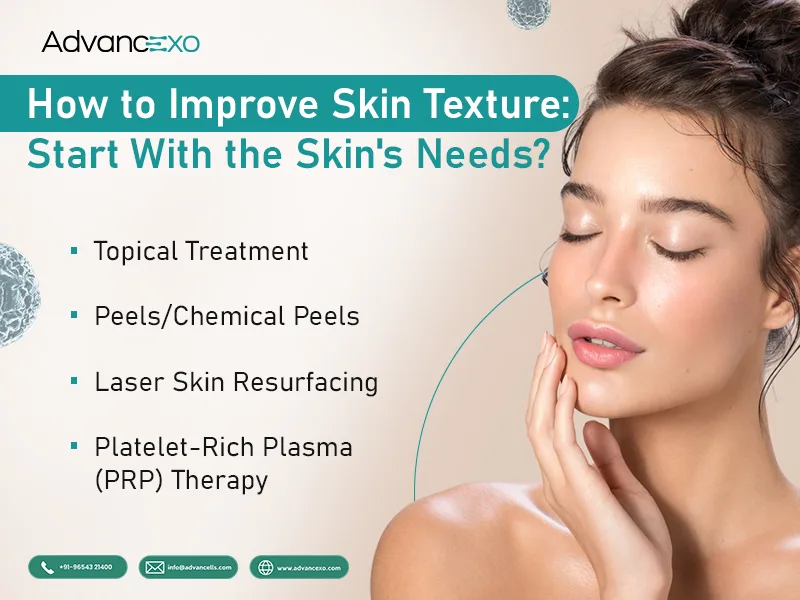
How to Improve Skin Texture: Start With the Skin’s Needs?
Achieving a Smoother Skin Tone is Based on Identification of the Actual Skin Issue. The Common Treatment Options Include:
Topical Treatment
- Regular use of active ingredients, including moisturizers, exfoliants, and targeted ingredients to address specific issues (dryness, oily skin or uneven texture)
- Active ingredients (hyaluronic acid, ceramides, glycerin, etc.) are introduced for skin moisturization, hydration and restoration of barrier function.
- Softer exfoliation with ingredients (AHAs and BHAs) removes dead skin cell buildup. This boosts cellular turnover that leads to Smooth Skin Texture.
Peels/Chemical Peels
- Introduced for smoothing rough skin patches, pore minimization, and scar or fine line fading
- Boost collagen and elastin production and fill up the shallow acne scars.
- Based on the skin problem, chemical peels recommended include superficial peels (glycolic, salicylic, or lactic acid), medium peel (TCA), and deep peel (phenol)
Laser Skin Resurfacing
- Targets acne scars, enlarged pores, fine lines or wrinkles
- Focused beams remove damaged outer layers of skin and stimulate collagen or elastin production.
- Ablative laser (carbon dioxide or erbium) vaporizes the outer skin layer, smoothing the deeper scars.
- Non-ablative laser targets the underlying tissue without removing the outermost layer. This improves mild roughness or enlarged pores.
Platelet-Rich Plasma (PRP) Therapy
- A small volume of blood is withdrawn from the candidate’s body.
- Blood is centrifuged to obtain PRP.
- PRP (rich in growth factors) is injected at the target site
- The approach stimulates elastin and collagen production, softens the uneven skin texture, and fades scars or pigmentation.
- It boosts cellular renewal and restores glow.
*NOTE: The above treatment regimens are well-established; however, they do not target the changes at the cellular or molecular level. This has popularized the idea of introducing a regenerative approach as a natural and long-term solution.
Where Do Exosomes Fit Into Skin Rejuvenation?
Exosomes for skin texture improvement are a regenerative solution that targets the cellular and molecular level. Exosomes are tiny extracellular vesicles (30-150 nm) released by cells. They act as cargo for bioactive molecules. They act as cellular messengers that potentially trigger collagen production and boost natural Repair. The mode of action includes:
- Regeneration and Repair: exosomes release various signalling molecules and cytokines. They boost cellular communication and promote the body’s natural repair mechanism. The growth factors modulate signalling molecules that stimulate cellular regeneration
- Boost Collagen and Elastin Production: Exosomes stimulate fibroblast synthesis that boosts production of major structural proteins, including collagen and elastin. This results in regaining firm and smoother skin. This reduces fine lines and wrinkles
- Accelerate Cellular Turnover: Promotes healthy cell renewal that minimizes enlarged pores, uneven rough skin patches and acne scars
- Reduce Pigmentation: Exosomes potentially regulate melanocyte activities that target melanin production. The excessive melanin accumulation in cases of hyperpigmentation and melasma gets broken down. This smooths the Uneven Skin Texture and tone
- Anti-Inflammation and Immunomodulation: Exosomes multiple anti-inflammatory molecules, they efficiently combats pro-inflammatory cytokine signalling. Exosomes modulates immune response and calms the skin microenvironment
What are Realistically Expected with Exosomes?
Exosomes are rapidly evolving regenerative solutions that can address multiple skin textures issues simultaneously. However, the research with exosomes is still evolving, and there is a need to develop large-scale clinical trials to establish long-term efficacy. It is crucial to set realistic expectations with exosome application, including:
- The outcome depends on exosome quality, source, isolation procedure, and administration process
- For skin texture improvement procure clinical-grade, well-characterized exosomes
- The changes occur gradually; do not expect an overnight solution
- The improvement in skin textures, tone and quality depends on the symptom severity
- The candidate might require multiple sessions depending on the change in skin texture and other individual factors
- Dermatologists often combine topical exosome application with other established methodologies like microneedling and regular skincare
- It is crucial to follow the aftercare instructions to gain a long-term solution
- Rely on evidence-based care, consult an experienced dermatologist and use renowned clinical products for the best outcome
*NOTE: Advancexo, India is a leading manufacturer and supplier of clinical-grade exosomes for skin and hair rejuvenation. The product comes with a Certificate of Authentication (CoA)
Key Takeaway
- Skin textures improvement is a multifactorial aspect
- Identification of the actual skin problem helps in choosing an effective solution
- Exosome topical application is a modern-day advanced solution for gaining smooth skin textures
- Consult an experienced dermatologist and a renowned clinic when opting for an exosome-based approach
- Focus on the exosome quality, source and authenticity rather than focusing on the cost factor
FAQ’s
Q- What Causes Uneven Skin Texture?
Uneven skin textures can result from ageing, dehydration, sun exposure, acne, enlarged pores, and changes in collagen and skin renewal.
Q- How to Improve Skin Texture?
Skin textures improvement requires a consistent skincare routine (sunscreen> 50 SPF, gentle cleansing, moisturization and hydration). Consult a dermatologist for professional aesthetic approaches based on individual needs.
Q- Can Exosomes Improve Skin Texture?
Exosome-based approaches are being explored for their potential to support skin quality, hydration, and a smoother-looking skin surface.
Q- How Long Does Skin Texture Improvement Take?
Results vary depending on the skin concern, treatment approach, and individual response. Skin-quality changes are generally gradual rather than immediate.


