Hair thinning doesn’t happen overnight. For many individuals, the problem begins with wider parting, a receding hairline, or more strands on the pillow than usual. While conventional treatments remain important in managing hair loss, researchers are exploring whether the biology of the hair follicle itself offers new ways to support hair growth. This has brought exosomes for hair loss into the spotlight of regenerative aesthetics.
Exosomes are tiny nano-sized molecules (50-150 nm) that act as carriers of multiple bioactive molecules. They actively stimulate multiple cellular signals. Researchers explore the potential of Exosomes for Hair Loss to target dermal papilla cells, activate follicular stem cells, and create a healthier scalp microenvironment. These findings have sparked interest in exosome hair treatment as an emerging area of investigation.
Thus, it is crucial to explore the science behind exosomes for hair loss. Early studies have reported encouraging findings. The current article explores the proposed mechanisms, current limitations, and potential place of exosomes for hair loss in aesthetic practice. It separates scientific promise from expectations and unveils the future potential.
Is Hair Loss More Than a Follicular Problem?
Hair loss involves clinical conditions that have multiple biological alterations. This involves:
Hair growth cycle disruption: The hair cycle involves four distinct phases. (i) Anagen phase or growth phase; (ii) Catagen phase or transition phase; (iii) Telogen phase or resting phase; and (iv) Exogen phase or shedding phase. Disruption of the normal hair cycle disrupts adequate hair growth. The key cause includes:
- Follicular Miniaturization: Progressive shrinkage of hair follicles. The hair follicle transforms from thick terminal hair to shorter, thin and fragile vellus hair. The hair eventually stops growing
- Chronic Low-Grade Inflammation: Silent cause of hair damage. Excessive pro-inflammatory cytokines disrupt the normal hair growth cycle. Adequate blood and nutrient flow in the scalp is disrupted
- Genetic Cause: Hereditary or pattern hair loss (androgenetic alopecia) is common where DHT hormone is upregulated. They bind with genetically sensitive hair follicles and shortens hair at the anagen phase
- Autoimmune Cause: Also known as alopecia areata. The individual’s immune cells recognize the hair follicle as foreign. It leads to hair loss.
- Hormonal Fluctuation: Certain changes in hormonal levels (pregnancy, postpartum, or thyroid fluctuation). This leads to significant hair loss. The reversal of the hormonal level restores hair growth naturally
- Other Conditions: Side effects of certain conditions, infection, alteration of the scalp microenvironment, etc., increase hair loss
Why are Exosomes Explored for Hair Growth?
Exosomes for hair loss are widely explored in aesthetic dermatology. Exosomes are tiny extracellular vesicles (30-150 nm) that act as clinical messengers. They carry multiple bioactive molecules, including proteins, microRNAs, cytokines, signalling molecules, lipids and growth factors. Currently, researchers have widely explored exosomes derived from mesenchymal stem cells (MSCs) due to their regenerative and paracrine signalling potentials. They potentially boost hair follicle proliferation, improve blood circulation and improve scalp health. They can prolong the anagen phase of the hair cycle.
How Exosomes Influence the Hair Growth Cycle?
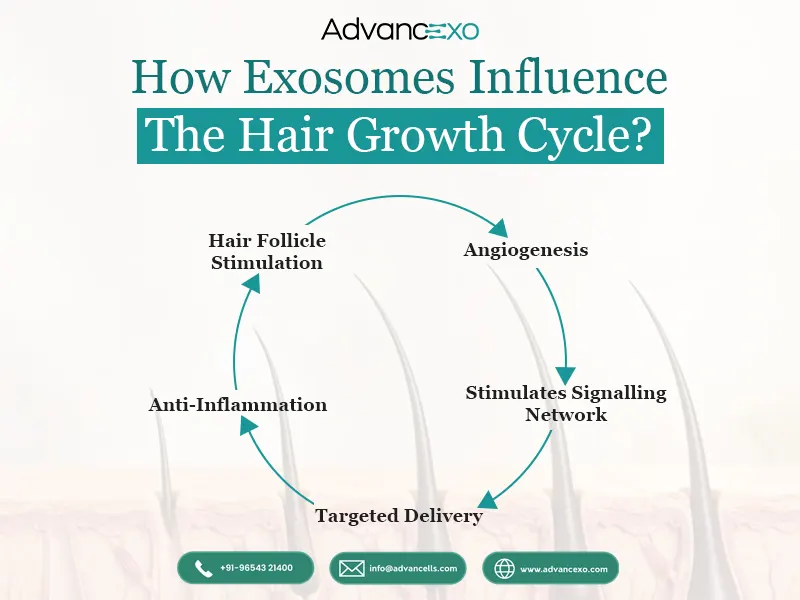
Exosomes for Hair Growth Target Multiple Cellular Mechanisms Simultaneously. This Includes:
- Hair Follicle Stimulation: Exosomes stimulate dermal papilla cells and activate follicle stem cells. They boost dermal papilla cell proliferation and enhance hair regrowth. The reactivation of the hair follicle supports entry of the follicle into the anagen (growth) phase
- Angiogenesis: Exosomes release various growth factors (VEGF, FGFs, ICGF-1) that support formation of tiny blood vessels. This supports blood, nutrient, and oxygen flow in the scalp. They support hair follicle activities
- Anti-Inflammation: Exosomes release various anti-inflammatory cytokines. They combat the action of pro-inflammatory signalling molecules. They calm down the scalp microenvironment. They modulate immune response and create a favourable environment for hair growth
- Stimulates Signalling Network: Exosomes modulate the signalling network (Wnt/β-catenin). They extend the active growth phase of the hair cycle
- Targeted Delivery: Exosomes are delivered directly to the targeted area. This enhances Hair Regrowth Treatment efficacy with exosomes
What Does Current Research Present?
The preclinical and early clinical evidence of exosomes for hair loss has set a positive trend in hair restoration. The key outcomes include:
- Improved hair density among candidates at the early to moderate stage of androgenetic alopecia
- Increased hair density in cases of alopecia areata
- The clinical outcome depends on certain factors like exosome quality, source, administration process, and individual factors. The result appears in 2-6 months
- Dermatologists often introduce exosomes for hair loss alone or in combination with microneedling or PRP for enhanced outcomes
- However, the research and clinical application are at an early stage. There is a need to standardize product source, controlled trials, and development of large-scale and long-term safety data [1]
Exosome Hair Treatment in Aesthetic Practice: Where Could It Fit?
Exosome Hair Regrowth Treatment has shown Positive Outcomes Among Candidates Facing:
- Patterned hair loss (both men and women), or androgenetic alopecia
- Autoimmune conditions (alopecia areata), where the immune response attacks hair follicles
- Telogen effluvium, a condition where diffuse hair thinning occurs
- Diffuse unpatterned alopecia
- Combats scalp inflammation, a major cause of excessive hair fall
What Should Dermatologists and Clients Consider?
Both dermatologists and candidates must consider certain factors before opting for Exosomes Hair Treatment. These include:
- Consideration of exosome quality, origin, purity, and batch consistency
- Well-characterized product, standardized formulation, and targeted use
- Evidence-based products, maintained storage conditions
- Set realistic expectations before opting for hair regrowth treatment
- Consult an experienced dermatologist and a renowned clinic for the treatment
*NOTE: Advancexo, India, is the leading manufacturer and supplier of exosomes for hair and skin rejuvenation. The exosomes are well-characterized and strictly maintain batch consistency. The product is accompanied by a Certificate of Authentication (CoA).
The Road Ahead: From Cellular Signalling to Clinical Evidence
Exosomes for hair loss improve hair density, thickness, and hair quality across various causes. The outcome varies among candidates based on exosome quality and individual factors. The current evidence has established a positive trend. In future, the focus is on standardizing source, exosome quality, isolation procedure, and administration. The focus is on launching large-scale clinical trials to establish long-term efficacy and safety.
References
- Queen D, Avram MR. Exosomes for treating hair loss: a review of clinical studies. Dermatologic Surgery. 2025 Apr 1;51(4):409-15.
FAQ’s
Q- Can exosomes for hair loss stimulate hair growth?
Exosomes are studied for their role in cellular communication and for stimulating follicular activity. Early research suggests their ability to influence hair growth. In the future, the focus is to launch well-controlled clinical studies to treat hair loss.
Q- How does exosome hair treatment work?
Exosome hair treatment aims to use extracellular vesicles carrying biological signals. Researchers are investigating how these signals may affect dermal papilla cells, hair growth-cycle regulation, and the scalp microenvironment. The results vary based on formulation and treatment approach.
Q- Are exosomes for hair growth suitable for every type of hair loss?
No, exosomes for hair loss efficiently target various causes. This includes hormonal changes, genetic factors, autoimmune conditions, nutritional deficiencies, etc. However, the treatment suitability depends on the individual’s factors and detailed health assessment.
Q- Is exosome hair treatment vs conventional hair regrowth treatments comparable?
Conventional treatments (minoxidil and finasteride) have established evidence in combating hair loss. In contrast, exosome hair treatment remains an emerging area of research. The treatment efficacy depends on the hair loss type, severity, and individual factors.