Are you noticing uneven patches on your face that have become stubborn? Exploring advanced regenerative solutions can help.
Healthy skin isn’t just about gaining a clear complexion. Healthy skin involves broader aspects like how the skin feels, reflects light, and maintains natural smoothness. Uneven texture, rough patches, fine lines, and stubborn pigmentation gradually change the way skin looks. Melasma, a common skin condition that accounts for persistent pigmentation patches. Conventional skincare remains at the core of skin management. However, it does not combat the problem at its root. Current regenerative aesthetics approach involves exosome-based skin rejuvenation. Researchers and dermatologists are replying on exosome applications widely. These exosomes are tiny extracellular vesicles that modulate cellular communication, melanocyte activity, inflammation, and immune response. They carry various bioactive molecules like proteins, microRNAs, lipids, and other signalling molecules. The current article focuses on exploring how modern skin rejuvenation could move beyond surface-level care towards a more comprehensive understanding of skin health.
What Causes Melasma?
Melasma is a common skin pigmentation condition that is characterised by blue-gray or brown patches on the skin. The most common areas affected include the nose, chin, forehead, and upper lip on the face. Other affected regions can be the arms, neck, or back. Normally, melasma commonly occurs during pregnancy (mask of pregnancy), mediated by hormonal fluctuation. Based on the pigmentation, melasma is sub-categorized as:
- Epidermal: Dark brown coloured patches with well-defined borders
- Dermal: Light brownish or bluish colour; it has a blurry border, difficult to treat
- Mixed Melasma: Has both bluish and brown patches, shows a mixed pattern; maximum cases of recurrence
*NOTE: Melasma appears as a chronic skin condition that lasts for more than three months. The treatment challenge is mainly its recurring nature
How is Melasma Recognised?
Melasma causes dark brown/bluish or brown coloured patches or freckles. Based on the location, melasma is recognised as:
- Brachial: Appearance on shoulders or upper arms
- Lateral cheek pattern: on one or both cheeks
- Centrofacial: Appears on the forehead, nose, cheeks, and upper lip
- Malar: Cheeks and nose
- Neck: Sides of the neck
- Mandibular: Jawline
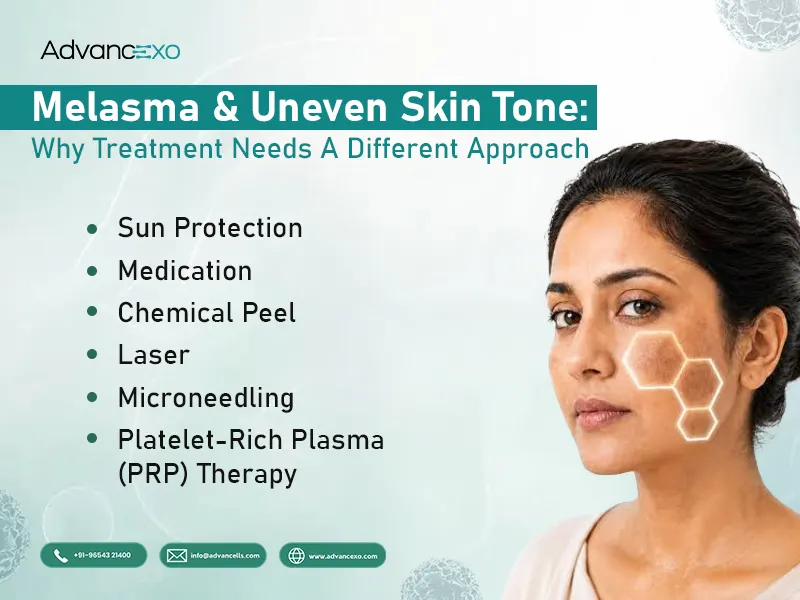
Melasma and Uneven Skin Tone: Why Treatment Needs a Different Approach
Conventional melasma skin treatments are well-established and are widely recommended by dermatologists. They involve the introduction of:
Sun Protection
- Introduce broad-spectrum sunscreen (>50SPF++) and protective clothing
- Sunscreen with ingredients including zinc oxide, iron oxide, titanium dioxide
Medication
- Hydroquinone (only prescribed by dermatologist)
- Tretinoin (mild corticosteroid) is introduced. They combat underlying chronic low-grade inflammation
- Combination cream including tretinoin (retinoid), hydroquinone, and corticosteroid
Chemical Peel
- Dermatologist-guided procedure; ingredients depend on the skin type and suitability
- Glycolic acid, mandelic acid, lactic acid, salicylic acid, TCA, AHA, or BHA
Laser
- Uses light energy to break down excessive melanin granules into smaller pieces
- Body’s immune system clears out the smaller fragments
Microneedling
- Tiny punctures created on the targeted region
- Modulates melanocyte activity and boosts collagen production
- Improves skin texture, makes the skin even-toned, and heals skin
Platelet-Rich Plasma (PRP) Therapy
- Melasma treatment for sensitive skin involves PRP introduction obtained from the candidate’s own blood
- PRP is enriched with growth factors and signalling molecules, but depends on the candidate’s health condition
*NOTE: Conventional Melasma Skin Treatment addresses symptom management mainly at the surface level. Researchers and dermatologists are widely relying on exosome-based approaches as a rejuvenative solution for melasma treatment for dark skin and melasma treatment for sensitive skin.
Exosomes in Skin Renewal: Exploring Cellular Communication
Exosomes are nano-sized (30-150 nm), uniform lipid bilayer vesicles that are released by cells. MSC-derived stem cells are widely explored for both skin and hair rejuvenation. They consist of a wide range of bioactive molecules, including proteins, lipids, microRNAs, growth factors, hormones, and other signalling molecules. Exosomes for melasma skin treatment potentially have versatile functions. The key mechanism includes:
Melanocytes Modulation
- Exosomes release various signalling molecules, microRNAs, and cytokines
- They modulate melanocyte activities by increasing melanogenic enzyme expression, including tyrosinase and MITF
- It modulates melanin-keratinocyte communication
Anti-Inflammation & Immunomodulation
- Exosomes release various anti-inflammatory molecules and combat pro-inflammatory cytokine activity
- It reduces chronic low-grade inflammation surrounding the affected regions
Repair Mechanism and Cellular Regeneration
- Exosomes release various growth factors and cytokines
- They boost repair signalling and regeneration
- Exosomes introduction helps with barrier repair and controls pore size
Improve Skin Texture
- Exosomes regulate fibroblast activities and support structural function
- Exosomes boost collagen and elastin production. It improves skin texture and facilitates even tone
Combining Modern Skincare with Regenerative Approaches
Dermatologists often combine routine skincare approaches, conventional approaches with regenerative solutions to gain the best outcome. Routine skincare involves:
- Regular use of broad-spectrum sunscreen (>SPF 50+++)
- Gentle skin cleansing and use of moisturizer
- Gentle exfoliation at regular time intervals; avoid excessive exfoliation
- Use products recommended by the dermatologist, especially in case of sensitive skin
Dermatologists often combine advanced skin care regimens like peels, laser, microneedling, or PRP with exosomes for Melasma Treatment for Sensitive Skin.
*NOTE: The outcome varies among individuals depending on the exosomes’ quality, source, isolation procedure, administration, and storage conditions. Dermatologists determine the suitability of the exosomes application in melasma for sensitive skin. Advancexo, India, is the leading manufacturer and supplier of clinical-grade exosomes for skin and hair rejuvenation. The product comes with a Certificate of Authentication (CoA).
What Does the Future Hold for Exosome-Based Skin Rejuvenation?
- Skin rejuvenation science is moving beyond conventional surface-level treatment.
- The growing interest in modulating problems at the cellular level has raised interest in regenerative aesthetics.
- Exosomes deliver various bioactive molecules that modulate cellular communication, anti-inflammation, immunomodulation, boost cellular repair, and support cellular rejuvenation.
- For melasma treatment in dark or sensitive skin, exosomes modulate melanocyte activities.
- Dermatologists often combine microneedling with exosomes for better penetration into skin layers; they combat skin problems from within.
References
- Shah M, Dukharan V, Broughton L, Stegura C, Schur N, Samman L, Garcia‐Meraz C, Macaraeg‐Jimenez JL, Belo VG, Majewska L, Valle RG. Exosomes for aesthetic dermatology: A comprehensive literature review and update. Journal of Cosmetic Dermatology. 2025 Jan;24(1):e16766.
- Nahm WJ, Nikas C, Goldust M, Horneck N, Cervantes JA, Burshtein J, Tsoukas M. Exosomes in dermatology: a comprehensive review of current applications, clinical evidence, and future directions. International Journal of Dermatology. 2025 Nov;64(11):1995-2010.
FAQ’s
Q- How to make skin smoother?
Healthy-looking skin begins with following a consistent skincare routine. This involves carefully choosing regular moisturisation, gentle exfoliation, adequate hydration, and daily sunscreen use. Exosomes induce regenerative changes, boost collagen and elastin production, and make the skin healthier, smoother, and plumper.
Q- Can Exosomes Help Improve Skin Texture?
Exosomes are gaining attention in aesthetic dermatology for their role in cell-to-cell communication. They carry bioactive molecules that may influence collagen-related signalling, skin renewal, and the skin’s overall microenvironment. Researchers are exploring their potential to improve skin quality, although their long-term benefits and clinical effectiveness are still being studied.
Q- What is considered when choosing melasma treatment for dark or sensitive skin?
Melasma treatment for dark or sensitive skin requires adapting a gentle skincare routine. This involves gentle cleansing, sun protection, and adapting dermatologist-recommended treatments. Considering advanced exosome-based solutions can protect and uplift skin barriers and improve patchy appearance.
Q- Are Exosomes a promising option for Melasma and Uneven Skin Tone?
Exosomes are studied for their potential to influence cellular signalling, inflammatory responses, and melanocyte activity modulation. These properties have generated interest in their possible role in pigmentation management and skin rejuvenation.