
Why is There a Shift in Hair Fall Treatment Avenue?
Hair fall or thinning is distressful for both men and women. Hair fall treatment avenues have shifted from using oils, shampoo, serums or temporary cover-ups. At present, individuals are more focused towards finding science-backed solutions.
The therapeutic interest shift has brought more attention towards platelet-rich plasma (PRP) therapy or regenerative solutions like exosomes therapy. Both options stimulate hair growth and aim to restore hair volume.
Exosomes vs PRP understanding is vital to make sound choices that align better with your scalp and hair goals, and adapt to a long-term hair restoration journey.
Understanding the Science Behind Hair Fall
Losing 50-100 hair strands daily is natural. If you observe more hair strands in your brushes, on clothing or in drains, that’s unusual. The normal hair cycle consists of four distinct phases:
- Anagen (Growth) Phase: Active hair growth phase, lasts 2-8 years
- Catagen (Transition) Phase: Short phase, in which the hair follicle shrinks. It lasts for 2-3 weeks
- Telogen (Resting) Phase: Hair follicles rest, lasting for 3 months
- Exogen (Shedding) Phase: Last phase, old hair falls out
Hair fall or hair thinning is characterised by shortening of the anagen phase. The cause can be multiple, including:
- Androgenetic Alopecia: Hereditary/ pattern baldness
- Alopecia Areata: Autoimmune cause
- Telogen Effluvium: Premature hair shedding can be due to prolonged illness, stress, or hormonal imbalance.
- Traumatic Alopecia: Harsh hair styling technique, strong chemicals, excessive heat use
What Is PRP Therapy?
Platelet-rich plasma therapy is an established technique where the patient’s own blood is used to stimulate hair growth. PRP is a rich source of autologous platelets that consist of growth factors, including VEGF, PDGF, TGF-β, and IGF-1.
PRP Works as Follows:
- Patient’s blood is drawn in a sterile condition
- Blood is centrifuged, and PRP is extracted
- Isolated PRP is injected at the hair-thinning site
- Growth factors delivered activate the dormant hair follicles
The Core Benefits Include:
- Use the patient’s own biological material (autologous)
- Improve hair thickness and scalp health
- The least possibility of immune rejection
Limitations of PRP Include:
- Requires multiple sessions (4-6)
- Limited success rate and gradual improvement over months
What is Exosome Therapy?
Exosome therapy has evolved in regenerative dermatology. In recent times, exosome therapy has gained attention for its ability to deliver faster, consistent and long-term results. Exosomes are nano-sized (30-150 nm) bioactive molecules. It’s a ‘cargo’ that carries multiple particles, including essential proteins, signalling molecules, microRNAs, and cytokines. Researchers have widely explored exosomes derived from mesenchymal stem cells (MSCs) for hair fall treatment.
The Key Mechanism Via Which Exosome Works:
- Improved Cellular Communication: Exosomes release various growth factors and signalling molecules. It facilitates active cellular communication.
- Stimulates Hair Follicle: Exosomes stimulate the dermal papilla and activate hair follicle stem cells. It reactivates dormant hair follicles and pushes the hair follicles into anagen (growth) phase.
- Anti-Inflammation: Exosomes combat chronic inflammation surrounding hair follicles. It releases anti-inflammatory molecules (proteins- IL-10, TGF-β; microRNAs- miR146a, miR21)
- Improve Blood Circulation: Exosomes promote angiogenesis, improving nutrient and blood supply to the scalp. Creates a healthier scalp microenvironment
- Immunomodulation: Exosomes regulate innate and adaptive immunity response by limiting inflammatory responses, lymphocyte proliferation and boosting the T-cell population. Suitable for an autoimmune hair loss condition
Key Benefits of Exosome Therapy Include:
- Exosomes simultaneously targets multiple cellular and molecular mechanism
- Fewer sessions are required, produces long-term visible results
- Effective for individuals experiencing early to moderate stage hair loss
Unveiling the Core Difference: Exosomes vs PRP
PRP vs Exosome Therapy creates confusion in effective hair loss treatment. While both techniques aim at hair rejuvenation, their mechanism of action, suitability, and results widely vary [1].
Comparative Analysis: Exosomes vs PRP for Hair Loss
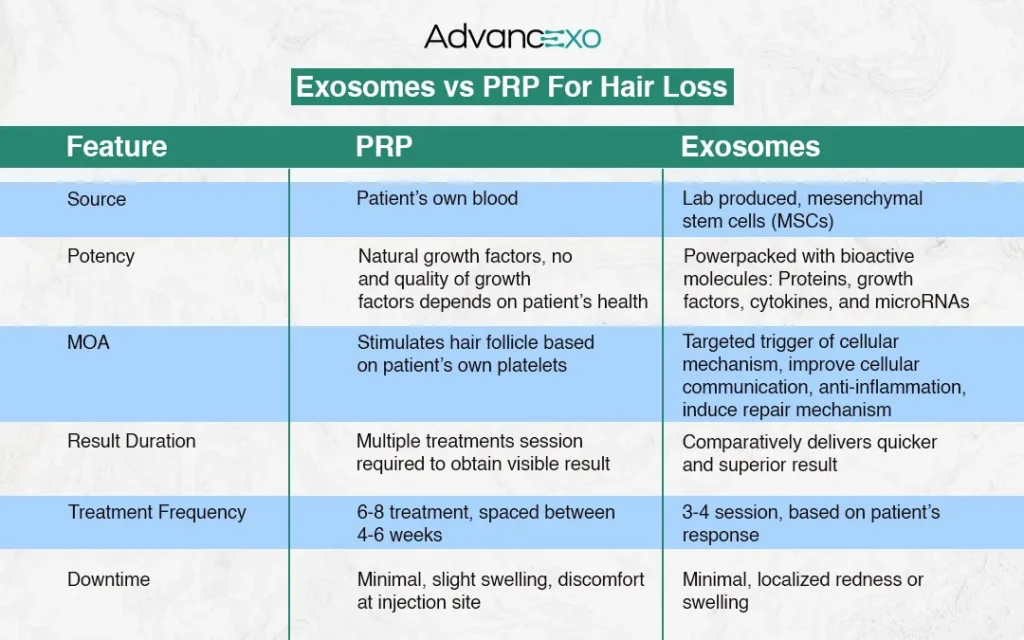
| Feature | PRP | Exosomes |
| Source | Patient’s own blood (Autologous Source) | Lab produced, mesenchymal stem cells (MSCs), derived from naive tissue or cells, enable strategic management of cellular signalling |
| Potency | Natural growth factors, carrier similar information/ signalling that is already available in patient’s body | Powerpacked with bioactive molecules: Proteins, growth factors, cytokines, and microRNAs; the quality and number of growth factor are intense (similar to new born) |
| MOA | Stimulates hair follicle based on patient’s own platelets | Targeted trigger of cellular mechanism, improve cellular communication, anti-inflammation, induce repair mechanism |
| Result Duration | Multiple treatments session required to obtain visible result | Comparatively delivers quicker and superior result |
| Treatment Frequency | 6-8 treatment, spaced between 4-6 weeks | 3-4 session, based on patient’s response |
| Downtime | Minimal, slight swelling, discomfort at injection site | Minimal, localized redness or swelling |
Which Option is Best for You?
Choosing between exosome therapy and PRP for hair growth depends on multiple factors:
Hair Loss Severity
- For the early stage, PRP is effective.
- For more advanced hair loss, exosome therapy produces a better outcome. They introduce advanced regenerative capabilities.
Cost Factor
- PRP is more affordable, yet requires multiple sessions to gain visible results
- Exosome therapy is more expensive, but displays better results in fewer sessions.
- Result Speed
- PRP timeline is longer. Visible results appear after several sessions, and it takes months to produce results.
- Exosomes therapy isn’t a miracle treatment either; the change occurs gradually but at a faster pace. Noticeable results appear after 1-2 sessions.
Client’s Preference
- Patient preferring a more natural option goes for PRP
- Exosome therapy is new, among many, its adaptation can be a potential taboo
- Individuals who opt for an advanced science-backed option prefer exosome therapy
What are the Factors that Trigger the Success of Exosome Therapy?
False or big marketing claims often influence exosome therapy. Before deciding on exosomes vs PRP for hair loss controversy, consider the following aspects:
- Exosome quality matters; the molecules must be of superior quality
- Choose renowned clinics that have produced desirable results
- Consult experienced clinicians, discuss the treatment procedure and desirable outcome
- Set clear expectations, consider all pros and cons before opting for the treatment
*NOTE: Advancexo, India, is the leading supplier of superior quality clinical-grade exosomes for hair regrowth. Exosomes are supplied, undergo a stringent quality check process, and are maintained in a controlled environment before reaching the clinic.
Combining Exosomes & PRP: Is Dual Therapy Considerable?
Yes, exosomes and PRP can be combined to enhance hair regrowth outcomes. When used together, they produce synergistic results. PRP stimulates hair follicles via growth factors. Exosomes deliver more than 1000 bioactive molecules at a time. Clinical studies have revealed that patients who did not see significant change with PRP alone have received better outcomes with the combined approach.
Currently, exosome therapy for hair restoration is at an early stage of therapeutic application. The focus remains on developing large-scale clinical trials for establishing its long-term efficacy, tolerance and safety.
Final Takeaway: Exosomes vs PRP — Which One Fits Your Hair Goals?
There is no clear win-win answer between exosomes and PRP for Hair Loss. PRP is a well-established, tried and tested method. Exosome therapy has emerged as a regenerative solution that produces superior outcomes. In the PRP vs exosome controversy, exosome therapy can be superior in certain instances. It delivers power of regeneration, consistent results, enhances cellular communication and produces long-term outcomes.
References
- Rubaian NB, Alghamdi SM, Alahmadi M, Alhijab A, Alshamrani T, Hakami H, Almehaideb L, Alghamdi L, Alahmadi H, Alanazi GB. Exosomes versus Platelet-rich Plasma in Hair Loss Therapy: A Comprehensive Literature Review. Journal of Advanced Trends in Medical Research. 2025 Oct 1;2(4):671-81.
FAQ’s
Q- Is Exosome Therapy Better than PRP for Hair Loss?
The superiority of the procedure depends on hair loss severity, the client’s preference, and the suitability of the treatment based on the patient’s health.
Q- How Many PRP Sessions are recommended?
PRP requires multiple sessions to produce desirable results. 6-8 sessions are required; each session is scheduled at a different time.
Q- Is PRP or Exosome Therapy Painful?
Exosome therapy is minimally invasive; it is often combined with microneedling for the best outcome. PRP requires drawing blood from the patient before injecting platelet-concentrated plasma into the scalp. Both procedures are non-surgical and incur the least procedural pain.
Q- Is Exosome Therapy Safe for Both Men and Women?
Yes, exosome therapy is suitable and safe for both men and women.

I hadn’t realized that exosome therapy works through cellular communication rather than just stimulating growth like PRP. It’s fascinating to think how understanding these mechanisms could influence more personalized hair restoration approaches in the future.
Thankyou for taking the time to appreciate our article. We’re glad you found the information useful and insightful. Our goal is to provide readers with reliable, science-backed knowledge that is both informative and easy to understand. We are also a leading exosome supplier for hair and skin. For more information or collaboration inquiries, Please contact us via WhatsApp or call us at +91-9654321400, or mail us on info@advancells.com for more information. We’re here to support you every step of the way.