Hair Fall- A Rising Concern
Hair fall is not just a cosmetic issue; it’s your body’s way of silently signalling an internal imbalance.
Your hair reflects everything that’s happening underneath, i.e., from nutritional gaps to modern lifestyle stressors. Aging and genetics are often blamed for hair loss, but nutritional deficiencies are overlooked, which silently weaken your hair follicles from within. We often ignore how the right nutrition and a little push via natural means can restore the balance.
We help you understand the since-linked behind diet and hair loss. Hereby, explore how the Nutritional Deficiency restoration paired with advanced solutions can get your hair growth on the right track.
The Science Behind Hair Growth and Hair Loss
Hair growth is sub-categorized into four distinct phases:
- Anagen Phase: The growing phase, the longest stage of hair growth, lasts between 2 and 8 years. In this phase, the hair follicles are predominantly active, and 80-85% of your hair on the scalp is in this phase
- Catagen Phase: Transition phase, Hair follicle shrinks, and the hair growth slows down. The phase lasts for approx. 2 weeks, and 1-3 % of the hair is in this phase
- Telogen Phase: Resting phase, hair growth remains halted, but does not fall out; the phase lasts between 2 and 3 months, approximately 9% of the hair is in this phase
- Exogen Phase: Shedding phase, the hair sheds from the scalp, approximately 50-100 hair strands fall normally. With the fall of older hair follicles, new hair follicles push hair regrowth.
The above stages are a normal part of the hair growth cycle. However, the disruption of normal hair cycle stages results in excessive hair fall, leading to baldness.
Diet and Hair Loss: How Nutrition Impacts Hair Health
Genetics, hormone balance, and nutritional efficacy. Correct diet and hair loss are dependable factors that are manageable with little extra effort. Dietary modification with adequate intake of macros and micros can do wonders for your bouncy, vibrant locks.
Extensive scientific research has demonstrated a clear connection between nutritional deficiency and hair loss. These are as follows:
- Deficiencies in Vitamin A, E, D, B12, B6, Folic acid, magnesium, calcium, iron, and iodine are common deficiencies in men and women that contributes in excessive hair shedding (alopecia) [1]
- Nutritional deficiency impacts hair structure and growth rate. Decreased protein intake and niacin deficiency significantly contributes in chronic telogen effluvium in all forms of hair loss (androgenetic alopecia, female patterned hair loss, or alopecia areata) [2]
What Dietary Change Can Reverse Hair Loss?
Intake of essential macros and micros in your daily life can do wonders for your locks. Some changes include:
Correcting Micronutrient Deficiency
- Vitamin D, major contributor to female pattern baldness and autoimmune alopecia areata. Safe exposure to sunlight for 10-20 mins daily, fatty fish, and fortified food
- Iron stress disrupts the normal hair cycle. Key sources include green leafy vegetables, red meat, liver, and dark chocolate.
- Zinc plays a crucial role in adequate immune function. Zinc deficiency is widely reported in alopecia areta, telogen effluvium, male pattern baldness, and female pattern hair loss. Major source shell fish, legumes, nuts, and seeds
- Some other micronutrients like biotin, riboflavin, copper, folate, etc. Major food source includes eggs, liver, fatty fish, fortified food, nuts or seeds.
Correcting Macronutrient Deficiency
- Protein restriction is a major contributor to weakened hair strands
- Calorie restriction adversely affects energy and nutritional supply to the hair follicle. Pushes hair follicles from the anagen phase to the telogen phase
- Protein-rich food intake and efficient calorie supply combat the nutritional needs
*NOTE: Correct nutritional deficiency alone might not be enough for every individual. A little push via modulating cellular signals can bring that expected long-term solution
Advanced Hair Regrowth Treatment: Role of Exosome Therapy
Exosomes, once thought to be ‘cellular trash’, have become topmost choice for dermatologists to combat the hair fall problem. The tiny vesicles are active cellular messengers that make the Best Hair Regrowth Treatment a reality. Exosomes are extracellular metabolites released by cells that act as bioactive molecule cargoes. They efficiently carry essential proteins, microRNAs, cytokines, and growth factors. Dermatologists trust exosomes’ efficacy in advanced hair regrowth treatment that introduces changes efficiently.
Exosomes: Mechanism of Action
Research unveils the efficacy of mesenchymal stem cells (MSCs)-derived exosomes for hair regrowth. The cellular mechanism involves:
- Cellular Communication: The tiny packages release growth factors and signalling molecules. The recipient cells internalize the exosomes via fusion or endocytosis. They trigger cellular signaling and facilitate cell-to-cell communication.
- Stimulation of Hair Follicle: The dormant hair follicle is activated via stimulation of dermal papilla cells. Reactivates hair follicle stem cells, promotes hair follicle entry in the anagen phase.
- Improvement in Blood Circulation: Exosomes promote angiogenesis, facilitates adequate supply of nutrients and oxygen in the scalp
- Anti-inflammation: Exosomes release various anti-inflammatory cytokines (IL-10, IL-6, TNF-α), reducing scalp inflammation. Chronic inflammation is a prominent problem in androgenetic alopecia and alopecia areata
- Repair Scalp Damage: Exosomes support scalp tissue regeneration, creates supportive scalp microenvironment.
- Targeted Delivery: Exosomes are delivered directly to the affected area (region of hair loss). Produces a more enhanced outcome
*NOTE: Exosomes used for hair fall must be of superior quality. The procedure is performed under expert guidance. Advancexo, India, is among the renowned manufacturers of MSCs-derived exosomes for hair and skin rejuvenation.
What is the Most Effective Administration Method?
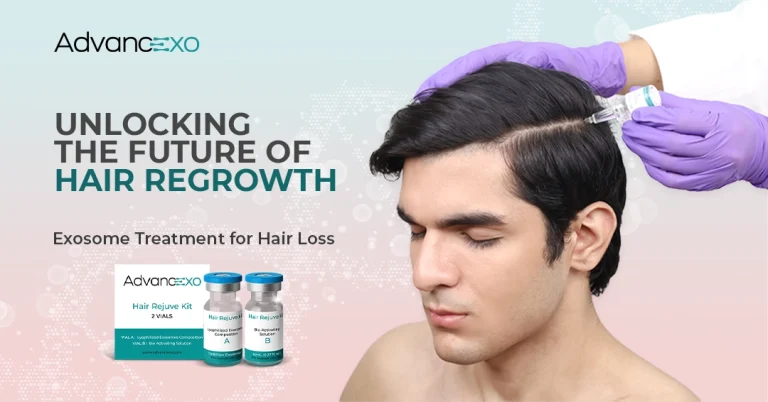
Exosome therapy combined with microneedling is an effective solution as the Latest Hair Regrowth Treatment. The procedure involves:
- Detailed scalp health assessment
- Cleaning the scalp area for exosome application
- Microneedles are used to create tiny controlled punctures (1.5-2.0 mm) in the hair loss area. Microneedling alone boosts collagen production to improve hair growth.
- Topical application of exosomes followed by gentle massaging
- Combining microneedling with exosome application allows deeper penetration of exosomes
- Aftercare, there is negligible downtime after the procedure. Avoid using harsh chemicals, strenuous activities (sauna, hot showers, swimming), hair styling products, direct sun or heat, etc., for atleast 72 hr after the treatment.
Combining Nutrition and Exosomes for Better Outcomes
Combating nutritional deficiency and exosome application potentially have positive long-term outcomes. The effect is synergistic, which includes:
- Targets the Root Cause of the Problem: Nutritional deficiencies correction and exosomes promote hair health naturally and internally
- Sustain Hair Growth Cycle: Restores normal hair growth cycle, improves cellular signalling, pushes hair follicles in anagen phase.
- Improve Hair Density and Scalp Environment: Reduces inflammation, improves microcirculation, and creates optimal growth conditions.
- Holistic and Synergistic Effect: Integrates internal nourishment with natural hair regeneration for optimal results
Tips to Prevent Hair Fall Naturally
- Switch into balanced diet intake with adequate macros and micros.
- Lifestyle changes, managing stress, insomnia, exposure to environmental stressors (dust, sunlight, toxins)
- Undertake exosome therapy at the early to moderate stage of hair fall for optimal results
Conclusion: A Holistic Approach to Hair Regrowth
The integration of a balanced diet and managing daily life stress creates a healthier scalp environment. Microneedling with exosome therapy enables hair regrowth naturally via amplifying internal signals. Overall, a combination of dietary modification and exosome therapy have synergistic effect as the best hair regrowth treatment.
References
- Almohanna HM, Ahmed AA, Tsatalis JP, Tosti A. The role of vitamins and minerals in hair loss: a review. Dermatology and therapy. 2019 Mar;9(1):51-70.
- Guo EL, Katta R. Diet and hair loss: effects of nutrient deficiency and supplement use. Dermatology practical & conceptual. 2017 Jan 31;7(1):1.
FAQ’s
Q- How Does Diet Affect Hair Loss?
Diet has a pivotal role in maintaining hair health. Nutritional Deficiency, including proteins, vitamins, and minerals, weakens hair follicles from the inside. This results in excessive hair shedding or thinning.
Q- What Nutritional Deficiencies are Common in Hair Thinning?
The most common deficiencies include Vitamin D, C, B12, zinc, biotin, riboflavin, and proteins. These nutrients have an intrinsic role in maintaining hair follicle health.
Q- Is Exosome Therapy Safe for Treating Hair Loss?
Preclinical and clinical research have confirmed the safety of exosome therapy in hair loss. Exosomes used for therapy should be of superior quality. An experienced professional must perform the procedure.
Q- Who is the Ideal Candidate for Exosome Hair Treatment?
Exosome treatment can be taken by all men and women experiencing early to moderate instances of hair fall or hair thinning.